

The question being pondered is, “What is Cognitive Science, and what is its place in Christianity? Specifically, as we consider modern sciences, modern progress, and an ever changing technological landscape… how does Christianity fit into a world that constantly seems to reject certain traditional belief systems, specifically Abrahamic Religions?”
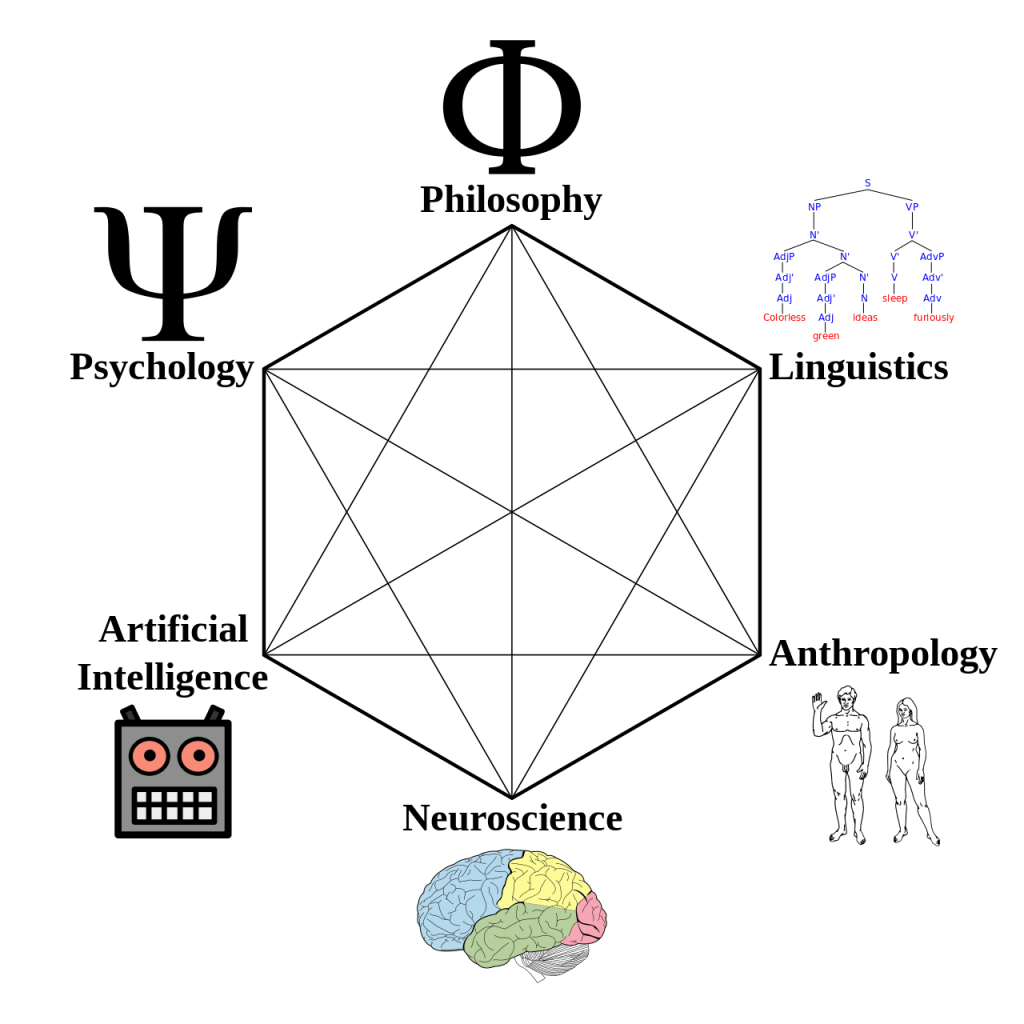
Philosophy, Linguistics, Anthropology, Neuroscience, Artificial Intelligence, and Psychology make up the most profound science, and the most salient science known to mankind. It is cognitive science, or the interdisciplinary study of universal cognition. In the image of God, mankind has developed the ability to fathom, reason, justify, rationalize, and even irrationalize itself into a coexistence with things both seen and unseen. Religions, ideologies, and cultural belief systems seem tangled together as the outsider looks in towards the human dilemma that is a dance between morality and mortality. Now, to break down the realm of cognition through its six renowned sciences while keeping the root of all knowledge of human history stemming from deep-rooted Christian theology.
Philosophy is the study of the fundamental nature of knowledge, reality, and existence especially when considered as an academic disciple. The four main branches of philosophy are metaphysics, epistemology, axiology, and logic. Globally renowned philosophers spanning thousands of years from the Greek Era that spawned Plato, Socrates, Aristotle and trailing towards the relatively modern minds of Jean-Jacques Rousseau (1712-1778), Sigmund Freud (1856-1939), and the infamous Friedrich Nietzsche (1844-1900). These minds have helped shape, and re-shape modern culture through comparisons of modern findings with their historical documents and ideas preserved over centuries.
Linguistics is the scientific structure of language and its structure, including the study of morphology, syntax, phonetics, and semantics. The branches of linguistics include sociolinguistics, dialectology, psycholinguistics, computational linguistics, historical-comparative linguistics, and applied linguistics. Some linguistics masters range from the father of Linguistics, “Panini” of India origin to the more recent developer of Facebook, Mark Zuckerberg.
Anthropology is the study of human societies and cultures, and their development. The two main branches of anthropology are cultural and sociological. Sub-disciplines can branch into linguistic anthropology, biological/physical anthropology, and also archeology. Some world renowned anthropologists are Louis Leakey (1903-1972) and his ‘Trimates’, and Franz Boas (1858-1942) who opposed the scientific racism theories that dangerously led towards ideologies like Nationalism and what became the foundations for beliefs that inspired the actions during the Holocaust of the twentieth century.
Neuroscience is any or all of the sciences, such as neurochemistry and experimental psychology, which deal with the structure or function of the nervous system and brain. Branches of neuroscience list heavily as neurophysiology, neuroanatomy, behavioral neuroscience, developmental neuroscience, cognitive neuroscience, systems neuroscience, molecular neuroscience, computational neuroscience, neuro-philosophy, neurology, neuropsychology, neuro-evolution and neuro-economics. One neuroscientist that is given much glory and attention is Michael Gazzaniga for his 20th century discovery of split-personalities and the labor differences between the left and right brain hemispheres. He, and Antonio Damasio hold twenty-first century recognition amongst neuroscientists globally.
Artificial Intelligence is the theory and development of computer systems able to perform tasks that normally require human intelligence such as visual perception, speech recognition, decision making, and translation between languages. Branches of artificial intelligence include experts systems, robotics, machine learning, neural network, fuzzy logic, and neural language processing. Considering the nature of Artificial Intelligence it is not possible to allocate a renowned person, but thanks to people like Elon Musk, Jeff Bezos, Bill Gates, Steve Jobs, and hundreds of dedicated doctors and engineers we can experience elementary A.I. through products like Siri, Alexa, self-driving cars, and sophisticated softwares mainly utilized for military safety and security across developed nations.
Lastly, Psychology is the scientific study of the human mind and its functions, especially those affecting behavior in a given context. The vast branches of psychology in the twenty-first century includes abnormal psychology, anomalistic psychology, applied psychology, behavioral neuroscience, cognitive psychology, cross-cultural psychology, cyber psychology, developmental psychology, evolutionary psychology, forensic psychology, gender psychology, mathematical psychology, moral psychology, occupational health psychology, parapsychology, psychometrics, social psychology, and somatic psychology. Sigmund Freud (1856-1939), B.F. Skinner (1904-1990) and Carl Jung (1875-1961) are all globally renowned scientists within this field.
One of the most common forms of distraction (away from God-Worship) through debate can be found in two scientists debating against each others preferred method of cognition. Whether linguistically, anthropologically, psychological, and philosophically, it is common to find disagreement when theories focalized around linguistics inappropriately match up with ones of anthropology. Consider a married couple who do not share the same mother tongue trying to decide which cultural holiday to spend finances on for house decorations… if love and understanding, or servant leadership, is not guiding the debate, then it may end up in one or both parties being offended.
Purposefully, neurosciences and the study/formation of artificial intelligence, is hard to debate between when the math adds up. If a computer coder types one wrong key, then the system will not work, and the problem has to be corrected or eradicated. So, rational proof in development will always supersede the irrational belief just as a person declaring a UFO sighting through generic media is very different than revealing to the public a tangible/viewable UFO. In our reality, we have to accept the headpiece of collective human conscience as being a thin veil called truth. It is the proof of faith that will lead to the church’s desire to see rippling influence and guidance towards the truth of Jesus.
Now, how do these thoughts on cognition relate to Christianity, the claims of Christ, the monotheistic worship of God, and balancing the dance between morality and mortality? First off, it would be important to notate the work of renowned preachers of recent era. C.S. Lewis (1898-1963), Billy Graham (1918-2018), N.T. Wright, Chuck Swindoll, Charles Stanley, Rick Warren, John MacArthur, Timothy Keller, John Piper, Andy Stanley, Francis Chan, Jentezen Franklin, Matt Chandler, and Max Lucado to name a few…
The collected works of these renowned theologians and preachers have allowed for modern-day Christians to be more prepared than ever when it comes to defending the faith of Christianity. Cross-Utilizing the platform of the pulpit and outreaching into the meta verse is an inevitable ‘next’ step in assuring that future generations have access to learning about the life and testimony of Jesus Christ along with discovering that God is real, and that He is desiring a personal relationship with every human daily and unconditionally.
As the church, we must see the gap in society (the space available for church evangelism) seems to be shrinking as the secular world latches onto technological development, social media management, and angel investments that continually implement morality/ethics rooted in psychology and cognitive sciences held strongly by non-believers (who proudly and collectively worship Money over God). This is revealed through the decisions made on both a national and global scale through political decisions, and selected political leadership that always births decisions with eminent outcomes that historically always lead to war, famine, disparity, social injustice, and the encouraged pursuit of materialism through corporate assets being both materialistic and a vast collection personal laborers while praising the illusion of diversity.
Understandably, the need for a healthy economy requires a supply and demand chain in balance, and understandably, the motivation to work hard is paralleled with a tangible return on investment. So, would the twenty-first century world know technology at its current state (or would there have been a collected drive to discover, research, and execute modern sciences) without the required imbalance inside the socioeconomic scale that allows for slave-like wages? Probably, not. This does not diminish the nature of science or scientists like Nikola Tesla, or Albert Einstein whose discoveries were nothing short of outcomes brought by far-right outliers on the Karl Gauss ‘Bell Curve’ of human intelligence.
What should be recognized is that the inequalities experienced by humans living in third-world countries (such as a lack of clean water) cannot be overlooked, or taken for granted, by citizens of first-world nations who laugh safely in the comfort of their high thread-count bedsheets after a four-course meal while watching TikTok videos being live-streamed from the other side of the globe. In other words, roughly quoting Will Durant from his masterfully woven series on human civilization, the luxuries of the city come from the blood sweat and tears of those amongst the countryside.
And so, Cognitive Science has to be taken serious amongst theologians, preachers, and common/everyday Jesus followers alike because the only way to evangelize in a modern world full of millions of people who can self-educate (from the Internet) is to obtain the tools required to match, or surpass, the level of faith held knowingly or unknowingly by any and every non-believer. Defending the Christian faith is one approach to ministry, but staying on the offensive can also have many rewards to those whose convictions lead them to always remain ready (in reference to expanding the kingdom of God on earth).
As always… God Bless,
James Arthur Ferguson
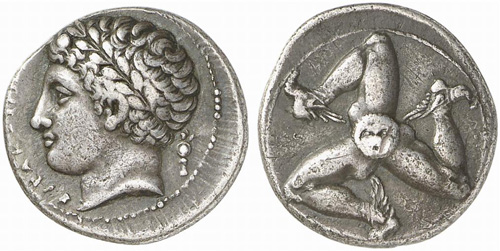
Below are symbolic representations of equilateral triangles (both mirrored and singular) that range from the dawn of modern Human Civilization to the twenty-first century. Noticing patterns in human understanding, and finding commonalities between civilizations that have long since past hopefully gives us a better understanding of cross-cultural human similarity, and hopefully gives us a glimpse at the interworking of the God who creating all things. If energy can neither be created nor destroyed, then energy in its total infinite spectrum and throughout all dimensions is all within God’s creation.
Considering the multiverse or cross-dimensional analysis is hard to fathom (and even harder to prove), but finding connectivity within the realm of earth and across human history is not as hard to prove. Consider these findings known to scientists for a long time and notice how so many people from different time periods, different civilizations, different cultures, different fields of study have drawn symmetry in their discipleship through symbolism.
In basic mathematics, or geometry, there is a purity found in the balance of an equilateral triangle. There is perfect symbolism in its trinity of three sixty-degree angles that have drawn architects, mathematicians, and artists towards its perfection like a mosquito to an evening lamp. There is a reason that the mathematical representation for balance has found its way into the history books time and time again over the rises and falls within each torch carrying civilization. Enjoy these examples…




 FergusonPoetryProject LLC
Leave a comment