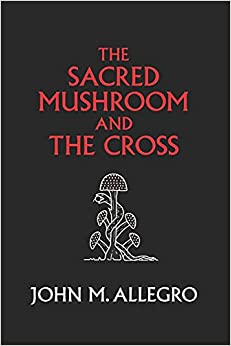
Let’s continue the work of analyzing the studies and findings of John M. Allegro in his book titled, “The Sacred Mushroom and The Cross”. It has been fun diving deeper into two specific branches of Cognitive Science that have, to me, been like far-distant cousins in my personal journey through life.
Linguistics and Anthropology, which are Allegro’s special fields of study, are of equal interest amongst the canopy that creates this fairly new and modern approach to knowledge and understanding. First, we must take a step back to understand where in the balance of cognition that Allegro finds his discoveries. Allegro has captured phenomenal research including ancient Sumerian culture and links between many renowned ancient cultures and their primitive religions by learning from ancient debris containing well preserved fragments with legible engravings. From Sanskrit and Hieroglyphs, to early Cuneiform that soon developed into modernized majuscule and minuscule linguistic, it can not be doubted that Allegro took pride in his profession whilst also adding much needed humor to what can be a dull and boring field of study to some.
September 11th in 1956 as the birth of modern realized Cognitive Science. This early form began casting an umbrella that would eventually cover all things Philosophy, Linguistics, Anthropology, Psychology, Artificial Intelligence, and Neuroscience. This cognitive revolution would soon become the stamp of what is known as the fundamental science and basic for understanding Intelligent Life, and in some cases Creation as a whole. This is Cognitive Science.
Allegro clearly has a mastery within two of the six fields of study, but let’s remember the total chain that assists one in grasping a complete outlook on intelligent life. It is recognized that linguistics, anthropology, philosophy, and psychology are all deeply encouraged and influenced fields of science dating back towards the first largely populated human civilization known as Mesopotamia. It can also be seen that the newer fields of Neuroscience and Artificial Intelligence are just now beginning to par (due to modern twenty-first century technologies and the internet) with opportunity and discovery at the rate of Greece during the ‘Four-Hundred Years of Silence’. This is the period where the prophets were silenced, and the period where Plato, Aristotle, Socrates, and the Roman Empire began taking shape.
Diving into the second chapter, ‘Sumer and the Beginnings of History’ Allegro backs the evidence of modern civilization beginning in Sumer. He maps out the land as Mesopotamia and also two of the four rivers mentioned in Genesis being Tigris and Euphrates. Even though the history of this civilization dates back a few thousand years it is known that just south of Sumer in the Southern Land of Mesopotamia was a city called UR. The map including Ur is noted on page ten. Genesis 11:31 describes the moment Abram (soon called Father Abraham) set out from Ur and settled in Haran.
As Allegro dives deeper into early forms of written communication and symbolism through pottery there is an even more intricate notice of letter formations curated by the process of diving stick into wet clay. It can be seen in the triangle-like shapes at the end of most lines. Allegro’s humor becomes very present through his repetitive acknowledgment of both fertility cult clues and a clear biological necessity for life to procreate.
Linguistically, there is a beauty in understanding the formation of both words in any given language and their building blocks. Considering English came from Latin which evolved from early Sumerian/Indo-European culture it is very interesting to look far east towards China who use a very complex form of hieroglyphs even to this day. The win, for hieroglyphs, is that is allows many cultures of many languages to communicate at a surface level. The issue is that deep-meaning and philosophical understandings can be much harder for the common man to grasp without the written word. This is in essence the critical nature of the Bible in modern faith. The written word of both mankind and global history can only be understood through linguistic competence and standardized intelligence.
Allegro summarizes chapter two with a secondary acknowledgment that pinpoints Mesopotamia as the earliest source of tablet carved inscriptions. This civilization in history becomes the birthing place of modern civilization. Alongside the safety of grouping in large numbers not only gave the common man the ability to live a life of comfort and safety compared to other nomadic cousins, but it also allowed the common man to pursue elements of life such as passion and hobbies. During this time there also begins a clashing of ideas, beliefs, and views of worship.
Chapter Three is titled, “The Names of Gods” as Allegro begins diving deeper into the inevitable realization that there are energies at play that far exceed the power of mankind during the early years of Mesopotamia and remnants of Sumerian culture. Allegro begins quickly revealing his own issues within the seemingly disruptive pattern in morality when comparing the Old and New Testaments of the Bible side by side. As a believer, the catalyst between the two portions is the belief in the Ultimate Reality that Jesus is who he claims to be. By understanding Jesus as the right person, at the right place, and at the right time it becomes a much easier pill to swallow as Jesus being the Christ. The Son of God and the Lamb of Humanity is found in Jesus and his sacrifice of bearing the weight of all humanities sin for the sake of humanity and its future. Jesus could see a future where mankind could be both right with God and one with God.
Bouncing back towards one half of Allegro’s claim is again on the concept of fertility. Believing in the creator, or the Father of creation, or God the Father, is recognizing that the creation of life was in fact just that… a creation. The believer sees that life is not a simple chemical reaction, but something that has to be touched, wanted, and fabricated by another life. Could one see the Universe as a lifeforms? Sure. Could one see the earth as a majuscule form of life? Sure. Could one debate the essence of God the Father being a pantheistic or panentheistic hand in our realm? Sure. These questions are not the theological focus.
The theological focus is on the trueness of Jesus and also the reality that Hebrew people come from a long line of well protected stories, narratives, and history that connect mankind today all the way back to the first recognized modern man and woman who are biblically referred to as Adam and Eve. To piggy back on the faith of Allegro seeing a fertility cult in the creation of Monotheism, it can be said that every culture in the history of mankind has formed through fertility ritual and cult-like tradition. This does not exclude Abrahamic religion.
Now, when it comes to the wide use of outside sources that induce different forms of intoxication like the Sacred Mushroom… it must be known that sobriety is absolutely more in line with purity than the former. Jesus says, “Man shall not live off bread alone, but by every word that comes from the mouth of God.”. This is the reality of both having a personal relationship with God, and also acknowledging that both grace and mercy has been extended in a way that far surpasses what any single man or woman deserves by their own personal works and faith.
Understanding the foundations of Mythology and the creative desires to explain the unknown world is a common effort to latch onto a faith and reason when there is no better option. As many independent thinkers recognize- There is always a clear distinction between fact and fiction. There is always a thick veil between mythology and history. One contains magic, sorcery, and creatures unseen whilst the other is more clearly a connection with common every day struggle alongside tangible evidence. A stone statue of Hercules is not as much a proof of his and Pegasus’ existence as the story of Mt. Vesuvius and the uncovering of the ash ridden Pompeii.
Lastly, as every paragraph can be broken down through forms of connotation and denotation, through personal feelings and intricate fact, or through personal experience and collective experience, it can be seen that that veil between faith entertained and faith neglected is as thin as the separation between the third and fourth dimension being space and time.
Fertility cults and their beginnings can justify man’s and life’s foundational need to escape mortality through death, but this does not fulfill or satisfy the psychological or philosophical desire to be at one with a personal God. The biological need to carry on is foundational in the essence of reproduction, but if Jesus was seeking immortality in this realm, then he would have taken the stance of Genghis Khan and he would have impregnated as many of his followers as possible to continue the ‘genes of the pure’ or the ‘genes of God himself’.
Abraham absolutely fell into the category of fertility cult ritual in his calling from God to ‘father many nations’, but this does not deter that from his success a lineage was formed that would result in the formation of Israel, its nations and peoples, and eventually King David and his historic bloodline. Allegro’s assumptions, hypotheses, and discoveries only strengthen the proof behind Abraham as being a real person from a real places in a real culture where the stories and narratives of the Bible and Torah took place. The history of all Abrahamic religions and specifically Christianity only become strengthened through these findings and realizations that the Word, giving mortal humans a taste of divine omniscience, may in fact create an ability to brush tips with the ‘knowledge of the gods’, but this again does not account for the Wisdom imbedded onto man through divine worship.
Just as Allegro leans on Christianity as stemming from a fertility cult does not account for Jesus and even Paul not bearing children, but Allegro’s take on the ‘Word’ does not account for wisdom in man. In fact, the knowledge that come from written language, and its dangers, appears in the very beginning of scripture as God implores the first humans, being Adam and Eve, to not eat the fruit that will make them like God in knowing both good and evil. What these ancient story tellers would probably have never fathomed is the day where mankind will denounce fact and latch to fiction. Ancient wisdom would have never foreseen a world where truth would be called lies and lies truth.
In religious history, Adam and Eve ate the fruit in pursuit of knowledge and in spite of wisdom. This is a reality that exists for every man and woman today. We do things that are not wise because we the knowledge of, “if it feels good, then it is good” takes over the wisdom of long-term outcome. This mentality is a catalyst for generational issues and curses. This mentality is a catalyst for callused faith. This mentality is the product of generation after generation becoming more lost and more separated from the grace, mercy, and truth of the Father.
I admire Allegro in his knowledge of Linguistics and Anthropology, but I do not envy his lack of wisdom regarding truth and love that only comes through faith in Jesus and the seeking of Truth. Despite his humor in presentation, there is a plea for community and a need to belong to a group of people who may have similar reasons to denounce both faith and human history by starting with the root of all modern religion, Father Abraham.
As Always, God Bless,
James Arthur Ferguson
 FergusonPoetryProject LLC
Leave a comment