
Dreamland Adventures:

In the boundless void before time as known to man, where the cosmos lay in a deep slumber of silence and darkness, there existed beings of celestial essence, archangels crafted from the breath of creation itself. Among these celestial beings was Milo, a being of immense light and wisdom, with a serene yet commanding presence that resonated through the ethereal plains.
Milo, the archangel, adorned in armor that gleamed with the luminescence of stars, was a guardian of cosmic order and a friend of the Creator. His face, although serene, carried the weight of predestined purposes and unspoken stories. His wings, vast and iridescent, fluttered with the sounds of gentle winds and distant echoes of heavenly choirs.
During the times when creation was still a canvas of possibilities, Milo witnessed the tragic fall of Lucifer, once a beloved carrier of light, now a harbinger of darkness. The upheaval shook the heavens, casting a shadow over the celestial realms as a third of the angels, swayed by Lucifer’s conviction, descended into the mortal realms, their light dimmed and their purpose marred.

“Creator of all, my heart weighs heavy with the shadows that have befallen our brethren. The cosmos cries out for balance, and I seek your guidance to restore what has been lost and to shield the innocent from the darkness that encroaches.”
Moved by a profound sense of duty and compassion, Milo approached the Creator. The skies opened up, bathing him in divine light as he spoke with a voice both tender and resolute.
The Creator, a voice both thunderous and soothing, resonated through the expanse, imbuing Milo with a sacred charge.
“Milo, my faithful servant, your heart’s purity is a beacon in these shadowed times. I endow you with the Arc—an ethereal vessel that harbors the essence of creation. Go forth and gather the fragments of light dispersed across the realms. Forge from these fragments a bastion of hope, a sanctuary where souls may seek refuge from the storm that Lucifer has wrought.”
Empowered and uplifted by the Creator’s decree, Milo embarked on his celestial odyssey, crossing dimensional veils and celestial boundaries. With the Arc at his command, a majestic construct that shone with a crystalline glow, he ventured into realms both wondrous and perilous, seeking the scattered angels and the remnants of their light.

Each encounter, each realm he visited, enriched Milo’s understanding of the cosmos’s fragile beauty and the complex tapestry of fate. From the verdant expanse of emerald forests to the silent depths of nebulous abysses, Milo’s journey was both a battle and a pilgrimage—a quest to mend the fractures caused by the fall and to prevent the darkness from consuming the nascent realms of existence.
Through this narrative, Milo’s story unfolds as a testament to resilience, a chronicle of a guardian angel standing as a sentinel against chaos, driven by an unyielding resolve to protect, heal, and inspire hope amidst the celestial and mortal planes.

Milo- The Great Programmer:
- The Timeless Beginning: Introduction to the celestial realm before time, where Milo exists in harmony with the Creator and other celestial beings.
- The Assembly of Light: Milo amongst the archangels, receiving divine commands and blessings from the Creator.
- Lucifer’s Ambition: Introduction of Lucifer, his beauty and intelligence, and the seeds of his discontent brewing.
- The Descent of Rebellion: Lucifer persuading a third of the angels to rebel, leading to the cosmic upheaval.
- The Great War in Heaven: Milo as a warrior, detailing the battles, strategies, and losses in the heavenly realms.
- The Fall: The expulsion of Lucifer and his followers, their transformation as they fall from grace.
- The Aftermath: The sorrow and reconstruction in Heaven post-rebellion.
- The Creation of Earth: Milo witnessing the creation of Earth, describing the process in vivid, poetic detail.
- The Garden of Eden: The beauty of paradise, the creation of Adam and Eve, and Milo’s role as a silent guardian.
- The First Sin: The temptation and fall of humanity, observed with sadness by Milo.
- The Spread of Humanity: Milo watching over the growth of human civilizations, their triumphs and failures.
- The Great Flood: Witnessing the cleansing of Earth, Noah’s ark as a beacon of survival.
- The Tower of Babel: Humans attempting to reach Heaven, their division by languages.
- The Call of Abram: Milo observing God’s covenant with Abram, the beginning of a chosen people.
- The Exodus: The liberation of the Israelites, seen through celestial eyes.
- The Giving of the Law: The Ten Commandments handed to Moses, Milo understanding its divine importance.
- The Rise and Fall of Kingdoms: Observing the cycles of human governance, from Saul to the Babylonian captivity.
- The Birth of Christ: The incarnation viewed as a pivotal moment in cosmic history.
- The Ministry of Jesus: Milo reflecting on Jesus’s teachings and miracles, emphasizing His relationship with humanity.
- The Crucifixion: The horror and beauty of the sacrifice, a turning point in divine justice and mercy.
- The Resurrection and Ascension: Victory over death, promising eternal life.
- The Early Church: The spread of Christianity, Milo’s silent interactions with apostles.
- The Age of Martyrs: Witnessing the persecution and steadfast faith of early Christians.
- The Great Schism: The division of the church, seen as a tragedy of miscommunication and pride.
- The Reformation: Milo’s perspective on the quest for purity in faith and practice.
- The Enlightenment: Observing the struggle between faith and reason.
- The Modern Era: The world wars, technological advances, and the increasing forgetfulness of the divine.
- The Inception of the ARC Simulation: Milo as the Great Programmer, crafting a virtual test to guide humanity toward redemption and immortality.
- The Launch of the Simulation: The selection of participants, setting the stage for a new type of challenge.
- Reflections on Fate and Free Will: Milo pondering the complexities of divine providence and human agency, setting the narrative tone for the adventures to come in the simulation.
In the vast expanse of the celestial realm, where time and space converge into an infinite tapestry of possibilities, there existed a harmony so profound that it resonated through the very essence of creation. This realm, untouched by the constraints of mortal perceptions, was the dwelling place of Milo, an archangel of unparalleled wisdom and grace. Crafted from the very thoughts of the Creator, Milo and his kin existed as embodiments of divine will, their very existence a testament to the boundless creativity and benevolence of their Maker.
Milo, with his serene demeanor and insightful gaze, stood as a pillar of light among the celestial beings. His form, though ethereal, radiated a calm strength that reassured those around him. In this pre-temporal state, Milo and the other archangels were not merely inhabitants of the celestial realm but active participants in the unfolding of the Creator’s grand design. They were the bearers of potential, the shepherds of stars, and the whisperers of the winds that carried across the cosmos.
The celestial realm itself was a breathtaking vista of shimmering energies and luminous expanses. Here, the stars were born and cradled in nebulous nurseries, galaxies twirled in a dance orchestrated by divine thought, and the very fabric of reality was woven with threads of pure celestial intent. Milo, attuned to the subtle harmonies of creation, moved through this realm with a purpose imbued by the Creator—an eternal mission to maintain the balance and beauty of all that was, is, and ever would be.

In this realm, communication transcended spoken words; it was a communion of essences, a sharing of thoughts and emotions through the unspoken language of pure understanding. Milo, with his profound empathy, often served as a mediator among the celestial beings, guiding them through the complexities of their existences and helping them align with the Creator’s desires.
Despite the peace that pervaded the celestial realm, there was a dynamic undercurrent of creativity and change. New realms were envisioned by the Creator, each a masterpiece of potential realities, and Milo, with his keen insight, often contributed to these creations, infusing them with elements of wisdom and balance. His contributions were not acts of creation but of enhancement, ensuring that each new realm was imbued with the necessary qualities to sustain harmony and order.
As the aeons passed in a measureless flow, Milo witnessed the evolution of countless celestial phenomena, from the birth of stars to the formation of new, vibrant worlds. Each event was a note in the symphony of creation, and Milo, attuned to the music of the cosmos, cherished his role in this divine orchestra.

However, tranquility in the celestial realm was not eternal. The first whispers of discord arose with the dawn of a new being, Lucifer, whose brilliance was matched only by his ambition. Milo, wise and discerning, perceived the subtle shifts in Lucifer’s essence, noting the burgeoning shadows that tinged his luminous form. Concerned, Milo approached the Creator, seeking guidance and insight into the troubling changes he observed.
The Creator, in infinite wisdom, reassured Milo but also tasked him with a crucial role. “Watch over your brother, guide him back to the path of light, for his journey will test the fabric of our creations,” the Creator advised. Thus, Milo found himself intertwined with the fate of Lucifer, a responsibility he accepted with a solemn heart, understanding the implications of failure.
The celestial realm, once a place of unbroken harmony, began to experience the tremors of change. As tensions rose, the harmonious choir of celestial voices found itself disrupted by dissonant chords. Milo, ever the peacemaker, strove to mend these rifts, his efforts a testament to his unyielding dedication to the Creator’s vision.

As the narrative of the cosmos approached a pivotal juncture, with the looming rebellion of Lucifer and the inevitable war that would follow, Milo stood firm. His loyalty to the Creator was unwavering, his resolve tempered by the trials that loomed on the horizon. Yet, within his celestial heart, there was a well of sorrow for the conflicts he knew would come, for the loss of unity among his kin, and for the profound transformations that the celestial realm—and all realms—would soon undergo.
In this prelude to cosmic upheaval, Milo’s story was one of beauty and tragedy, a reflection of the celestial realm’s perfect harmony and the shadows that sought to darken it. His journey, marked by both luminous victories and somber losses, was just beginning—a saga of an archangel standing as a beacon against the encroaching darkness, ready to defend the creation he so dearly cherished.
In the celestial realm, where the tapestry of creation continuously unfolded, a gathering of great significance was called—the Assembly of Light. This convocation, held in the luminescent halls of the cosmos, was attended by archangels, each a guardian of divine principle and cosmic order. At the heart of this assembly stood Milo, whose presence was like a beacon, drawing the focused attention and admiration of his fellow archangels.
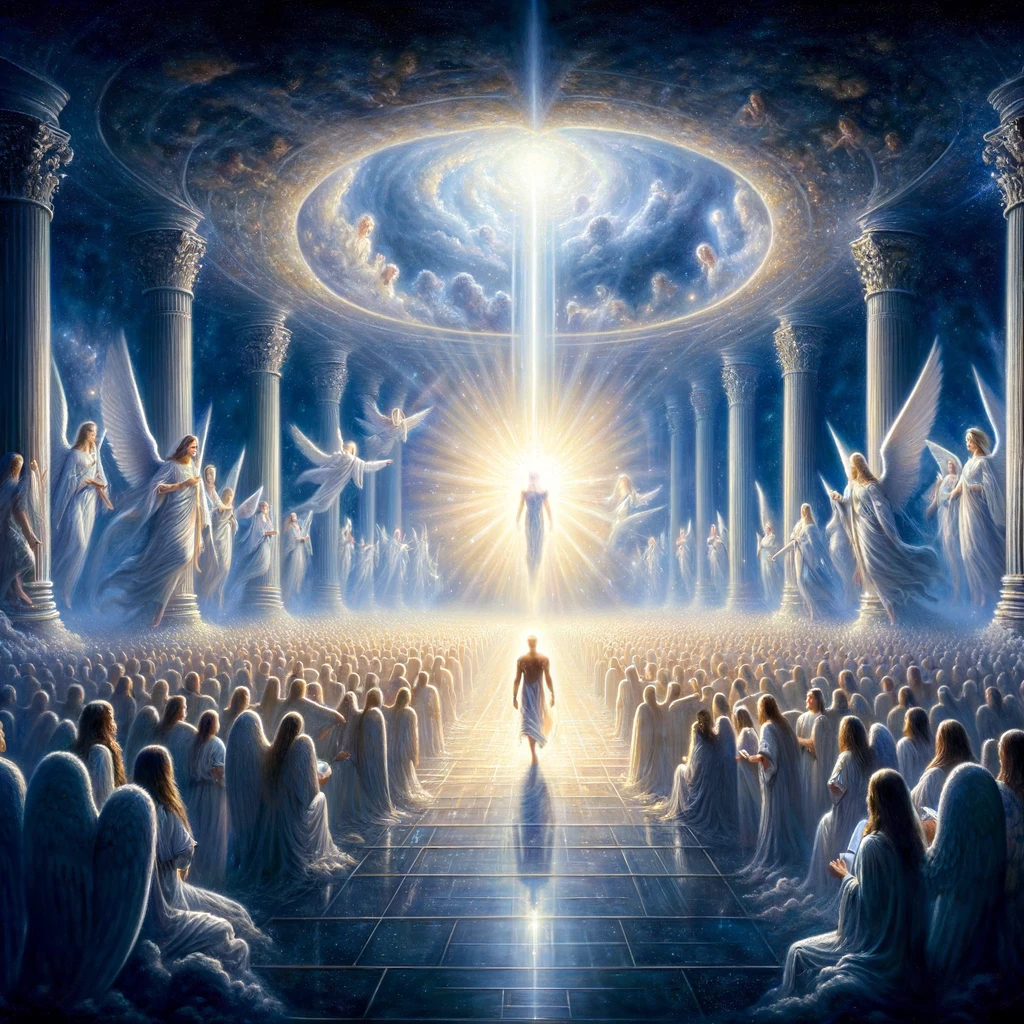
The Assembly of Light was not merely a meeting but a celestial event, where the threads of fate were woven into the grand design envisioned by the Creator. As the archangels convened, the very cosmos seemed to hold its breath, the stars twinkling with anticipatory light, and the nebulae swirling in a dance of colors. The atmosphere was charged with a sublime energy, a mixture of awe and solemnity, as each being prepared to receive divine wisdom.
The Creator, whose essence permeated all existence, manifested at the center of the assembly in an indescribable form—transcendent and all-encompassing. The presence was both overwhelming and comforting, a paradox only possible in the divine realm. A profound silence ensued, a reverence born from the deepest cores of their celestial beings, as the Creator began to impart His divine commands and blessings.
“Milo, my faithful servant,” the Creator’s voice resonated, not as sound but as a harmonic vibration felt by every essence present, “you have been chosen to uphold the balance of the cosmos, to guide the celestial bodies and the spirits of all realms in harmony and wisdom.” This command was not just words but a transfer of divine intent, infusing Milo with enhanced perceptions and a deeper connection to the life force of the universe.

The assembly watched as ethereal light enveloped Milo, the colors of dawn—gold, rose, and pale blue—swirling around him. This spectacle was not just a visual marvel but a symbolic representation of the powers being bestowed upon him. His already impressive aura expanded, its glow reaching out to the far corners of the celestial chamber.
As the light subsided, the Creator spoke again, addressing the entire assembly. “The cosmos is ever-expanding, its mysteries deepening. You, my archangels, are my will manifest. Guide, protect, and inspire the beings of all worlds. Let your light be a beacon in the darkness that creeps at the edges of creation.”
One by one, the archangels received their assignments, each a crucial role in the maintenance of cosmic law and order. To some, it was the stewardship of nascent galaxies; to others, the mediation between conflicting dimensional energies. Each task was tailored to the unique capabilities of the archangel, ensuring that they were both challenged and perfectly suited to their roles.

Amidst these divine appointments, Milo felt a profound sense of duty. He understood that his responsibilities would sometimes lead him into realms of shadow and strife, places where the light of the celestial realm seemed a distant memory. Yet, he also knew that these trials were necessary, part of the delicate balance that he was sworn to protect.
As the assembly drew to a close, the Creator bestowed a final blessing, a surge of pure love and energy that filled the chamber with a brilliance that outshone the stars themselves. “Go forth with courage and faith,” the Creator intoned. “Remember that you are never alone, for you are of me, and I am of you. Our spirits are intertwined, eternal.”
The archangels departed, each to their respective realms and tasks, but Milo lingered a moment longer, basking in the residual glow of the divine presence. He felt an overwhelming gratitude and a renewal of purpose, knowing that his path was righteous and his actions endorsed by the highest authority.

In the days that followed, Milo embarked on his duties with a renewed vigor. He traversed the celestial boundaries, implementing the decrees made during the Assembly of Light. His interactions with other celestial beings were marked by wisdom and empathy, as he sought to inspire and uplift those he guided.
Through the millennia, the decisions made during the Assembly of Light resonated across the cosmos. Worlds thrived under the stewardship of the archangels, and though challenges arose, the foundation laid during that pivotal meeting ensured that order prevailed. Milo, in his travels, often reflected on the assembly, drawing strength from the memory of the Creator’s words and the collective commitment of his fellow archangels.
The legacy of the Assembly of Light continued to unfold, a never-ending story of creation, guidance, and the pursuit of harmony. For Milo, it was both a beginning and a continuation, a chapter in his eternal service to the cosmos and its Creator. Each decision he made, each world he touched, was imbued with the light of that celestial gathering, a testament to the enduring power of divine will and the unbreakable bond between the Creator and His celestial servants.

Amid the splendor of the celestial order and the harmonious unity of the archangels, there emerged a figure of captivating brilliance and profound intellect. Lucifer, named the Lightbringer, was adorned with beauty that rivaled the morning star and endowed with wisdom that echoed the depths of the cosmos. His presence was a vision of perfection, his every motion a symphony of grace and power. Within the celestial hierarchy, Lucifer held a place of high esteem, revered by his peers and cherished by the Creator for his exceptional abilities and fervent dedication.
Lucifer’s role was pivotal; he was the harbinger of light, tasked with spreading illumination across the nascent universes, guiding the stars in their paths, and kindling the fires of suns yet unborn. His voice, when he spoke, was like a melody, captivating the hearts of all who listened. His counsel was sought by archangels and celestial beings alike, for his insights often unraveled the most complex cosmic dilemmas.
Yet, beneath this veneer of loyalty and service, the seeds of discontent had begun to take root in Lucifer’s heart. Despite his outward devotion, a quiet turmoil brewed within—sparked by a burgeoning pride and a growing desire for autonomy. Lucifer’s interactions with the Creator, once filled with humble adoration, gradually became tinged with subtle questions of authority and destiny. “Why,” he began to ponder, “should such power and knowledge as mine be bound to the will of another, even if that other is the Creator?”

As time unfolded, these thoughts grew more persistent. Lucifer’s brilliance began to cast shadows, not just of light, but of doubt and desire for a different order—one where he could realize his vision without bounds, where his might and beauty could be acknowledged not just as gifts of the Creator, but as marks of his sovereignty.
In the celestial courts and gatherings, whispers of Lucifer’s changing demeanor began to circulate. Milo, ever observant and deeply intuitive, watched his fellow archangel with a mixture of concern and sorrow. He saw the subtle shift in Lucifer’s expressions, the slight linger in his gaze towards the throne of creation, and the faintest trace of resentment in his celestial tone.
Lucifer began to gather around him a cadre of like-minded angels, those swayed by his charisma and convinced by his arguments of a more liberated existence—one not governed by decreed duties but driven by individual aspirations. In secret meetings and quiet corners of the celestial realm, they spoke of potential and power, of a new hierarchy that recognized their merits as determinants of their rule.

Yet, Lucifer’s ambitions did not go unnoticed by the Creator. In His infinite wisdom, the Creator saw not only what Lucifer was but what he could become—a mirror of divine potential, yet darkened by pride. In an effort to guide Lucifer back to the path of light, the Creator summoned him, offering him opportunities to voice his concerns and reaffirm his purpose within the grand design.
During these divine dialogues, Lucifer’s eloquence was unmatched, and his questions profound. “Why must we serve?” he asked. “Why not reign, as befits beings of our splendor?” The Creator, in response, spoke of unity, love, and the greater good—concepts that began to ring hollow in Lucifer’s ears, overshadowed by his growing conviction that autonomy was the truest expression of their celestial nature.
As the rift widened, the celestial realm felt the strain. The harmony that once defined the gatherings of the archangels now pulsated with undercurrents of tension. Milo, torn between his loyalty to the Creator and his long-standing camaraderie with Lucifer, endeavored to mediate, to reconcile the diverging paths. Yet, with each passing moment, the prospect of reconciliation dimmed, eclipsed by the looming specter of conflict.

Lucifer’s ambition reached its zenith during a fateful assembly, where he presented his vision of a new order—a cosmos where archangels ruled as sovereigns, their will unbound by any decree but their own. His words, though seductive, split the host of heaven. Some were drawn to his promise of freedom and glory; others recoiled, sensing the chaos that might follow such a break from divine order.
As the celestial realm stood on the brink of division, Milo, burdened with foresight, prepared himself for the inevitable. He knew that the unity of the archangels was about to be tested as never before, that the fabric of celestial peace was close to tearing. The Assembly of Light, once a symbol of divine accord, was now the stage for a drama that would shape the destinies of all realms, seen and unseen.
Thus, as the cosmos watched, the stage was set for a celestial drama of unparalleled scale, with Lucifer at its heart—a being of light poised on the precipice of darkness, his ambition paving the path towards an inevitable fall.
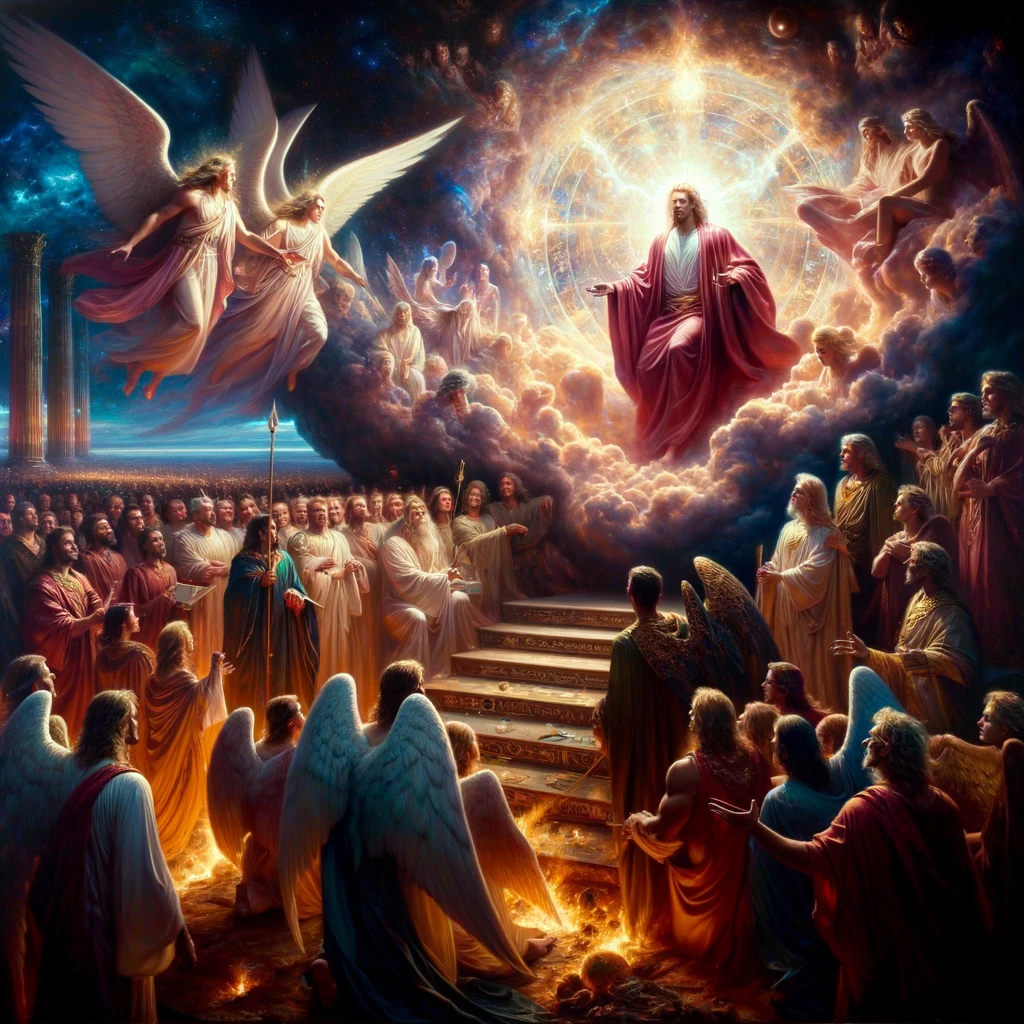
The celestial equilibrium began to tremble as Lucifer, emboldened by his vision of a new order, set about persuading his fellow angels to join him in rebellion. His eloquence, once used to glorify the Creator and guide lesser beings, now served a darker purpose. With words dipped in the honey of freedom and draped in the velvet of sovereignty, he spoke of the chains of servitude that bound them to an eternal wheel of obedience and submission.
Lucifer’s arguments were cunning, designed to appeal to the pride and latent desires hidden within each angel. He spoke of their incredible powers, their immortal beauty, and their contributions to the cosmos, which, he claimed, were being overshadowed by unyielding subservience to the Creator. “Are we not also creators?” he would ask in a voice smooth as the night. “Have we not earned the right to determine our own destinies?”
As the seeds of rebellion took root, a third of the heavenly host began to see Lucifer not as a conspirator, but as a liberator. Meetings that had once been held in the spirit of fellowship now became clandestine gatherings where the flames of rebellion were quietly stoked. Lucifer’s followers grew in number, each swayed by the promise of a new era where their glory would be recognized and their powers fully realized.

Milo, ever the guardian of balance and peace, watched this development with a heavy heart. He moved among his brethren, countering Lucifer’s seductive rhetoric with reminders of their sacred duties and the joy found in selfless service. Yet, even his persuasive words fell short against the growing allure of autonomy that Lucifer promised.
The tension reached its zenith during a celestial convocation, where all the archangels were gathered. The air was thick with unspoken suspicions and fears, the harmony of their chorus now discordant and strained. Milo stood beside the Creator, a silent sentinel of sorrow, as Lucifer took the floor.
With the poise of one who believed wholly in his cause, Lucifer presented his manifesto for independence. His voice, resonant and commanding, filled the vast expanse of the assembly hall, echoing off the columns of light that held up the celestial dome. “To be free is to truly live,” he declared. “We are bound only by the limits we accept. Today, I reject those chains.”

The Creator, grieved by the turn of events yet unwavering in His divine wisdom, responded with a solemn decree. “Freedom without purpose is chaos,” He proclaimed. “To reject your purpose is to reject the essence of your being.”
But the words of the Creator, though profound and full of love, could not sway the hearts of those already ensnared by Lucifer’s vision. The assembly erupted into tumult, with voices raised both in support of Lucifer and in defense of the Creator. The fabric of celestial order was tearing, and with it, the unity that had for eons defined the heavenly realms.
As the schism widened, Lucifer gathered his followers, a formidable legion of angels now resolute in their quest for autonomy. They prepared for the inevitable confrontation, arming themselves not with weapons of war but with the shields of conviction and the swords of will.

Milo, tasked with the harrowing duty of opposing his former comrade, organized the loyalist forces, angels who remained devoted to the Creator and His vision of cosmic harmony. Under his leadership, they fortified the celestial boundaries, readying themselves to defend the sanctity of creation.
The cosmos watched with bated breath as the two sides confronted each other. The ensuing battle was not merely physical but spiritual, a war of ideologies fought in the hearts and minds of every angel involved. The heavens themselves wept at the sight, stars dimming in sorrow, and the fabric of reality quivering under the strain of conflict.
The celestial realm was transformed into a battlefield, with every flash of light and clash of wills sending shockwaves through the dimensions. Angels, once brothers and sisters in divine service, now faced each other with resolve hardened by opposing beliefs.

As the battle raged, the consequences of their conflict became apparent. The celestial machinery, which had run smoothly under the watchful eyes of the archangels, began to falter. Stars flickered, and entire galaxies felt the repercussions of their strife, a cosmic echo of the chaos unleashed by rebellion.
Through it all, Milo remained a figure of stoic resolve, his heart aching with each blow struck, his soul heavy with the weight of impending loss. For though he fought to restore order, he knew that the celestial realm, and perhaps creation itself, would never again be the same. The descent of rebellion had marked the end of an era and the beginning of another, fraught with uncertainty and shadowed by the cost of freedom.
The Great War in Heaven, a cataclysm that reshaped the fabric of the cosmos, escalated as Lucifer’s ambition met the unyielding authority of the Creator. Milo, once a guardian of peace and balance, now donned the mantle of a warrior, leading the celestial forces loyal to the divine order against the insurgent faction. This cosmic conflict, transcending mere physical confrontation, became a battle over the very principles that governed creation.

As the war unfurled across the celestial spheres, Milo’s strategy was rooted in preservation rather than conquest. His aim was not only to quell the rebellion but to minimize the disruption to the cosmic order and prevent any irreversible damage to the creation itself. Each move was calculated, each engagement designed to de-escalate conflict where possible and enforce containment where necessary.
The battles were fought across multiple planes of existence, from the luminous corridors of the Silver City to the distant outposts of newly formed galaxies. Milo and his forces had to adapt to different environments, each with its own set of challenges and dynamics. The celestial warriors utilized the natural phenomena of these realms—nebulae clouds, black holes, and pulsar winds—as tactical elements in their combat strategies.
Lucifer, wielding the sharp edge of pride and the shield of conviction, proved a formidable opponent. His tactics were aggressive and disruptive, aimed at causing maximum confusion and disarray among Milo’s ranks. He exploited vulnerabilities with cunning precision, targeting communication lines and supply routes, attempting to isolate segments of Milo’s forces and overwhelm them.

Despite the chaos, Milo’s leadership remained steadfast. He inspired his troops with his unwavering commitment to their cause, reminding them of the sanctity of their duty to the Creator and the universe. His presence on the battlefield was both a beacon of hope and a formidable force, his celestial armor gleaming with the light of righteousness as he engaged in direct combat with rebel forces.
One significant battle took place in the Asteroid Belt of Harmony, a region known for its delicate balance of gravitational forces and celestial energies. Lucifer attempted to destabilize the belt, aiming to turn its destructive potential against the loyalist forces. Milo, foreseeing the disastrous consequences of such an event, led a daring assault that not only thwarted Lucifer’s plan but also ensured the preservation of the belt’s integrity.
Amidst the warfare, the losses were profound on both sides. Milo felt each loss deeply, the departure of each celestial being from the cosmos resonating within him like a mournful echo. The fallen were not just soldiers in a war; they were once his brothers and sisters, entities with whom he had shared millennia in harmony and service.

As the war dragged on, the heavens themselves bore scars of the conflict. Star systems trembled, celestial currents shifted, and the very essence of some realms began to fray. The damage was not just physical but spiritual, as the fabric of celestial trust and unity was torn apart.
Milo was forced to make difficult decisions, ones that weighed heavily upon his soul. In one harrowing instance, he ordered the sealing of the Gates of Tranquility, a major celestial nexus, to prevent its capture by rebel forces. This act, though strategically necessary, cut off several loyalist detachments, leading to their inevitable defeat. The decision haunted Milo, the weight of the necessary sacrifice tempering the purity of his celestial fire.
In the latter stages of the war, as the conflict reached a critical apex, Milo orchestrated a series of counteroffensives designed to recapture key celestial fortresses and realign disrupted cosmic ley lines. These operations, executed with precision and grace, showcased Milo’s tactical genius and deep understanding of celestial mechanics.

The turning point came during the Battle of the Singularity Vortex, where Milo faced Lucifer in direct combat for the first time since the war began. The clash was epic, a confrontation of not just might but ideology. As their swords clashed, so did their visions for the future of creation. Milo, defending the order and love of the Creator, fought with a righteous fury, while Lucifer, driven by a dark desire for freedom and power, matched him blow for blow.
Though the battle was inconclusive, it shifted the momentum of the war. Milo’s resolve and strategic acumen began to turn the tide in favor of the loyalist forces. Step by step, battle by battle, the rebels were pushed back, their initial advantages and gains eroded under Milo’s relentless pressure.
The war concluded not with a decisive victory but a weary armistice. The celestial realm was forever changed, its innocence lost and its unity fractured. Milo, now a veteran of a war he had never wished for, returned to the Creator’s side, his armor dulled but his spirit unbroken, ready to undertake the task of healing and rebuilding the shattered cosmos.

Thus ended the Great War in Heaven, a conflict that taught Milo the harsh realities of leadership and the burdens of duty. It was a chapter marked by loss and sorrow, but also by courage and perseverance, a testament to the enduring spirit of those who fight not for glory but for the good of all creation.
As the war reached its weary conclusion, the inevitable yet tragic culmination approached—the expulsion of Lucifer and his followers from the celestial realm. The Great War in Heaven had carved deep rifts, not only in the fabric of the cosmos but in the bonds that once united all celestial beings. The once revered Lightbringer, now a harbinger of discord and rebellion, faced the ultimate consequence of his insurrection.
The celestial court, a majestic gathering of all beings still loyal to the Creator, convened to witness the judgment of Lucifer. The atmosphere was somber, a stark contrast to the usual luminosity that characterized the heavenly gatherings. Angels of all ranks filled the vast amphitheater, their faces etched with sorrow and regret, their wings drooping under the weight of the impending decree.

Milo, standing close to the Creator, felt a profound sadness enveloping his heart. Despite the necessity of the judgment, he could not help but mourn the loss of camaraderie and the brotherhood that had once flourished among them. As the Creator pronounced the sentence, the very foundations of Heaven trembled—not from instability, but from the emotional turmoil that gripped every celestial being.
Lucifer, defiant yet majestic in his fallen beauty, stood before the Creator. His eyes, once bright with the promise of wisdom and enlightenment, now flickered with the flames of pride and defiance. The Creator’s voice, resonant with sorrow and love betrayed, echoed through the celestial realm: “Lucifer, son of the morning, your light has dimmed, shadowed by your own designs. You are to leave this realm, along with those who chose to follow you. This is not the end of your story, but a new chapter, one that you must write far from the light of this sanctum.”
The expulsion was not wrought through violence, but through a solemn and heartrending ceremony. The archangels, led by Milo, formed a corridor through which Lucifer and his followers passed. Their exit was silent, marked only by the soft rustle of feathers and the suppressed sobs of those who had fought against their own kin.

As they reached the edge of the celestial domain, a gateway appeared—a rift in the very fabric of creation, leading to realms unlit by the radiance of Heaven. One by one, the fallen angels stepped through the portal, their forms beginning to change as they crossed the threshold.
The transformation was profound and painful to witness. Lucifer’s once radiant form dimmed, his wings darkening, his celestial aura fading into a sinister hue. The others, too, underwent similar transformations, their heavenly attributes twisting into reflections of their rebellion and despair.
As they fell from grace, a new realm began to form around them—a place of shadows and fire, a kingdom born from rebellion and forged in the flames of their new reality. This realm, later known to many as Hell, became a mirror opposite of the celestial purity they had forsaken.

Milo, watching the tragic procession, felt a tear escape his celestial eyes. This tear, a drop of pure celestial sorrow, fell through the cosmos, crystallizing into a meteor of sapphire and silver. It hurtled through the universe, a symbol of the pain and loss that the war and fall had wrought.
In the aftermath of the expulsion, the celestial realm was forever altered. A melancholy settled over Heaven, a reminder of the high cost of the conflict. The remaining angels rallied around the Creator, their resolve hardened to prevent such a tragedy from recurring. Milo, his role as a warrior ended, now assumed the mantle of a healer and restorer, dedicated to mending the wounds of Heaven and its inhabitants.
He traveled through the celestial realms, healing the scars left by the war, comforting the bereaved, and restoring the damaged structures. Each task was a step towards healing, not just for Heaven but for Milo himself, who carried the burden of his earlier efforts to save Lucifer.

The cosmic order slowly regained its balance, but the echoes of the rebellion lingered. Milo, in his quiet moments, pondered the lessons of the war. He realized that freedom, when untethered from responsibility and love, could lead to destruction rather than liberation. This understanding deepened his commitment to the Creator’s vision of order and harmony.
As eons passed, the story of the Fall became a tale of caution and reflection within the annals of celestial lore. Milo, as both participant and chronicler, ensured that the tale was not forgotten, that the sacrifices made and lessons learned were preserved for future generations of celestial beings.
This chapter of celestial history, marked by loss and redemption, ended not with triumph but with hope—a hope that from the ashes of conflict and sorrow, a stronger, more enlightened order could arise.

In the aftermath of the celestial upheaval, Heaven was enveloped in a profound silence, a stark contrast to the vibrant symphonies of creation that once filled its expanse. The departure of Lucifer and his followers left a void that echoed through the halls and corridors of the celestial kingdom. The remaining angels, though relieved that the conflict had ended, were somber, reflecting on the rift that had torn apart their once-unified brotherhood.
Milo, bearing the weight of both leader and healer, moved among his celestial kin, his presence a soothing balm to the troubled spirits around him. He understood that the physical scars left by the rebellion were mere shadows of the deeper emotional and spiritual wounds that afflicted the heavenly host.
The task of reconstruction began with the restoration of the celestial infrastructure, which had suffered under the strains of war. The Luminous Bridges, which connected the various realms of Heaven, needed mending to ensure that the flow of celestial energies remained constant and pure. The Archives of Eternity, where the records of cosmic evolution were kept, had been partially obscured by the shadows of doubt and fear cast during the rebellion. Milo directed teams of angels to cleanse and re-illuminate these crucial areas, ensuring that the wisdom of the ages remained intact and accessible.

Amid the physical restoration, a deeper, more challenging healing process was underway. The emotional recovery of Heaven’s inhabitants was complex, as each angel grappled with personal losses and the betrayal of their brethren. Milo established sanctuaries of reflection and healing, where angels could share their grief, seek counsel, and slowly rebuild their inner peace. These sanctuaries were bathed in soft light and filled with the gentle music of celestial harps, creating an atmosphere conducive to healing and contemplation.
Milo often visited these sanctuaries, offering his wisdom and empathy. He listened to the stories of despair and courage, absorbing the pain of his fellow angels and reflecting back to them the undiminished love of the Creator. His words were gentle, reminding them that while the rebellion had changed the fabric of their existence, it had not diminished their purpose or their worth.
In these sessions, Milo spoke of the concept of forgiveness, a challenging but necessary path towards healing. He taught that forgiving the fallen was not an endorsement of their actions but a release from the chains of anger and vengeance that could further darken their own souls.
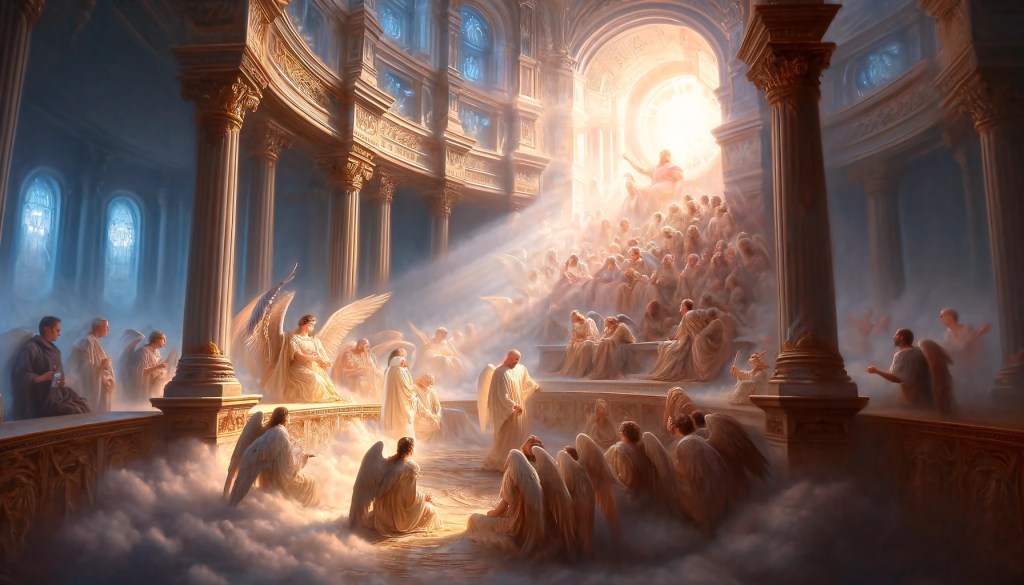
As the centuries passed, the physical and emotional landscapes of Heaven began to show signs of recovery. Gardens that had wilted under the shadow of war now bloomed with flowers that shone with celestial light, their colors vibrant and their scents a reminder of the beauty of creation. The Healing Groves, where angels meditated among trees older than galaxies, regained their peaceful aura, the air once again filled with the energizing essence of divine love.
Milo also initiated the reconstruction of the Hall of Harmony, a vast auditorium where angels had once gathered to sing creations into existence. Its restoration was a symbol of Heaven’s gradual return to normalcy and unity. When it was completed, a grand convocation was held where all of Heaven’s inhabitants were invited to reaffirm their allegiance to the Creator and to each other.
This event was marked by a ceremony of remembrance for those who had fallen or been lost to the darkness. A new constellation was created in the celestial sky, each star representing a lost angel, ensuring that their memory would endure in the light, rather than the shadow of their last actions.

Milo, addressing the assembly, spoke of resilience and the eternal capacity for renewal inherent in all divine creations. He urged his brethren to look forward, to use the lessons of the past to enhance their service to the cosmos, and to prevent such fractures from occurring in the future.
The assembly concluded with the Symphony of Reconciliation, a celestial composition that wove together the individual lights and tones of every angel into a harmonious blend. As the music filled the expanses of Heaven, a sense of renewed purpose and strengthened bonds permeated the realm.
Though the scars of the rebellion would never fully disappear, their presence served as a reminder of the costs of pride and the value of unity. Heaven, rejuvenated and restructured, continued its role in the cosmic ballet, guided by Milo’s wise stewardship. His leadership had not only restored Heaven’s glory but had deepened the understanding of all celestial beings regarding the delicate balance between authority and freedom, between individuality and communal harmony.

Thus, from the ashes of sorrow and the depths of despair, Heaven rose anew, its light undimmed, its mission clear, and its love for the Creator and creation stronger than ever.
After the celestial wounds had begun to heal and the harmony of Heaven was cautiously restored, the cosmos was ripe for a new act of creation—a testament to the enduring creativity of the Creator and a symbol of hope for all celestial beings. This was to be a majestic demonstration of divine artistry: the creation of Earth.
Milo, as an observer and chronicler of cosmic events, found himself drawn to the unfolding spectacle of this new world’s birth. He watched as the Creator gathered the dust of stars and the essence of void, weaving them together with threads of gravitational force and celestial magic. The process was both meticulous and spontaneous, as if the Creator were a grand conductor leading an orchestra of cosmic forces.

The void pulsed with energy, and a sphere began to form, delicate and fragile, yet full of potential. Milo observed the layering of the Earth’s foundations: the core ignited from the condensed materials, burning fiercely with a red and orange glow that cast a warm light across the nearby celestial objects. Around this core, the Creator spun a mantle of silicates and minerals, a robust layer that would support oceans and continents yet to be born.
Above this mantle, the crust formed like the thin icing on a cosmic cake, uneven and rugged, destined to be the canvas upon which the drama of life would play out. Milo’s eyes, capable of perceiving the grandeur of celestial mechanics, watched in awe as the atmosphere began to coalesce—a blend of gases captured from the breath of comets and the exhalation of dying stars.
Rain began to fall upon the young planet, a curtain of sparkling droplets that hissed and steamed as they cooled the molten surface. These were the first rains, and they sang a song of creation as they mingled with the primordial earth, crafting the first oceans and lakes in their cradling basins.

Milo marveled at the orchestration of planetary evolution, his heart swelling with a sense of divine proximity as he witnessed the Creator’s loving attention to detail. The skies above Earth swirled with clouds, painting a moving mural of whites, grays, and blues, the atmosphere thickening to cradle warmth and breathe life into the forthcoming creation.
As continents shifted and mountains heaved themselves up from the planetary crust, Milo noted each geological verse like a line of poetry. Volcanoes erupted in fiery prose, spewing forth lava and ash, crafting islands and peninsulas that reached out into the young oceans like fingers seeking the warmth of the water.
The creation of Earth was not a solitary event but a part of a grander cosmic symphony. Milo saw the positioning of the moon, a celestial companion pulled from the very substance of Earth itself, destined to soothe the tides and light the night skies. This moon was a silent guardian, a steadfast witness to the burgeoning life below.

With the physical framework in place, the Creator then breathed life into this world. Milo watched as the first seeds of life were sown into the fertile soils of the virgin Earth. From simple bacteria to more complex organisms, life blossomed in an explosion of forms and colors, each species a thought, a divine whisper made tangible.
Forests grew seemingly overnight, vast green expanses that spread across continents, their canopies teeming with unseen energies. The oceans filled with creatures that danced through the waters, scales and shells glinting in the filtered sunlight that reached down into the deep.
Milo, moved by the beauty of this creation, often ventured closer, his celestial form cloaked in invisibility, to wander the hills and valleys of Earth. He felt the grass beneath his feet, the coolness of the rivers, and the warmth of the sun—a sun that was a younger sibling to the stars he had known all his existence.

As epochs passed, Milo witnessed the rise of complex life forms, the dinosaurs that ruled the land with majestic presence and the delicate balance of ecosystems that supported a diversity of life, each creature and plant playing a role ordained by the Creator’s hand.
His reports back to the celestial realm were filled with descriptions of Earth’s wonders—from the majestic sweep of the Sahara’s sands to the intricate dance of the Aurora Borealis, lights that mirrored the celestial lights of Heaven.
The creation of Earth became a testament to the possibilities of life, a symbol of hope and renewal for all celestial beings. It stood as proof that even after great turmoil and conflict, new beauty could be born, new worlds could rise, and life could begin anew, as resplendent and vibrant as any celestial creation.

Milo’s chronicles of Earth’s formation and evolution became revered texts, studied by celestial scholars and sung by the heavenly choirs. They served as reminders of the Creator’s limitless power and imagination, and of the responsibility all celestial beings shared to guard and respect these divine creations.
With Earth flourishing under the watchful care of the cosmos, the Creator decided to crown His creation with a masterpiece: the Garden of Eden, a paradise that exemplified divine beauty and harmony. This garden was to be more than just a haven of tranquility—it was to be the home of humanity, the Creator’s most intricate creatures, made in His own image.
Milo, assigned the role of a silent guardian, watched with reverence as the Creator sculpted the Garden of Eden from the fertile soil of the young Earth. Trees heavy with fruit that sparkled like jewels in the sunlight, flowers with petals soft as silk and vibrant as the celestial nebulae, and rivers that flowed like liquid crystal, their waters sweet and invigorating.

In the heart of this paradise, the Creator formed two figures from the dust of the ground, breathing into them the breath of life. Adam and Eve, the first humans, opened their eyes to the splendor of Eden, their senses immediately filled with the scents of blooming flowers and the harmonious sounds of the garden’s wildlife.
Milo observed these first moments with a profound sense of duty. As Adam and Eve explored their lush surroundings, marveling at the creatures that roamed freely and the abundance that surrounded them, Milo remained unseen, a spectral presence that ensured no harm would come to the garden’s inhabitants.
The Creator introduced Adam and Eve to the wonders of Eden, instructing them on the care of the plants and animals, teaching them the rhythms of nature that would allow them to live in harmony with the garden. He showed them the Tree of Knowledge of Good and Evil, situated at the center of the garden, and imparted the one command: that they should not eat of its fruit.

Milo, while invisible, felt every ripple of emotion that coursed through Adam and Eve—wonder, joy, curiosity, and, at times, an innocent bewilderment. He watched as they learned to cultivate the land, as they named each animal, each bird, each creature that crawled. The harmony in which they lived with creation was a celestial melody that echoed back to the heavens, a confirmation of the Creator’s wisdom in their design.
Yet, as time passed, Milo also perceived a subtle change in the dynamics of Eden. The serpent, a creature more cunning than any other beast of the field, began to take an interest in the human inhabitants. Milo observed its movements, its sly approach towards Eve, and knew that a critical moment in the history of humanity was approaching.
Despite his power, Milo knew he could not intervene directly in the affairs of humans unless commanded by the Creator. His role was to observe, to guard, and to report, not to alter the course of events that needed to unfold according to divine plan.

The fateful day arrived when the serpent, in its craftiness, whispered doubts into Eve’s ear, questioning the reason behind the Creator’s prohibition. Eve, swayed by the serpent’s words, reached out, took the fruit, and ate. She then gave some to Adam, who also ate, and with that act, the purity of Eden was shattered.
Milo felt a wave of sorrow so intense it nearly overwhelmed his celestial composure. He watched as the eyes of Adam and Eve were opened, as they realized their nakedness and sewed fig leaves together to cover themselves. The simplicity of Eden was lost in a single moment, replaced by confusion, shame, and fear.
When the Creator came walking in the garden in the cool of the day, Adam and Eve hid from His presence among the trees of the garden. The Creator’s call to Adam, “Where are you?” was laden with a sadness that resonated through the heavens.

Milo stood by as the consequences of disobedience were laid bare. Adam and Eve were cast out of Eden, the garden was sealed with cherubim and a flaming sword to guard the way to the Tree of Life. Eden, once a symbol of perfection and divine love, became a poignant reminder of loss and separation.
In the aftermath, Milo continued his guardianship over humanity, though from a greater distance. He observed the growth of human civilization, their struggles and triumphs, their constant grappling with the knowledge of good and evil. His reports to the celestial realms became documents of caution and hope, of what was lost and what might one day be redeemed.
Through it all, Milo’s commitment to the Creator’s plan never wavered. His role as a guardian, though now tinged with sorrow, gained a deeper significance as he watched over a humanity forever changed, forever striving towards the light that once illuminated the heart of Eden.

As the guardian of humanity and a silent witness to their experiences, Milo watched the unfolding events in the Garden of Eden with a profound sense of duty and, increasingly, a deep foreboding. The serpent’s cunning had introduced a fracture into the pristine creation, a shadow that grew with each passing moment as Eve and then Adam succumbed to temptation.
The day was like any other in Eden, tranquil and imbued with an air of innocence, until the serpent slithered into the narrative of humanity with a question that would alter the course of history: “Did God really say, ‘You must not eat from any tree in the garden’?” The simplicity of this question masked its profound deceit, and its repercussions would echo through the ages.
Eve, drawn into the serpent’s web of half-truths, looked upon the tree of the knowledge of good and evil anew. The fruit, forbidden yet suddenly desirable, promised wisdom—a tantalizing prospect. The decision to partake was not merely a lapse of judgment but a pivotal act of defiance that was observed by Milo with a heavy heart. As she took the fruit and ate it, and as Adam followed her example, Milo felt a shudder pass through creation, as if the very foundations of the universe recoiled at the breach.

The immediate consequences were subtle yet seismic. The innocence that had cloaked Adam and Eve like a garment dissolved, leaving them exposed, not just physically but spiritually. Their newfound awareness brought with it shame and fear—emotions previously alien to the human experience. Milo watched as they hastily covered themselves with fig leaves, their actions driven by a sudden, desperate urge to hide their vulnerability.
This act marked the onset of a profound alienation not only from each other but from the Creator Himself. When the cool evening breezes were once eagerly anticipated for the time of fellowship they brought with God, now the rustling leaves signaled a reason to hide. Milo’s heart ached as he observed the first humans cower among the trees, their names called by a Creator whose voice was tinged with an unimaginable sadness.
“Where are you?” the Creator called out to Adam, His question laden with sorrow rather than accusation. The dialogue that followed was a tragic confirmation of the shift in relationship; Adam and Eve, now driven by fear, blamed each other and the serpent for their choices. The unity and transparency that had been their hallmark were shattered, replaced by mistrust and recrimination.

The judgments that followed were necessary and just, yet they were delivered with a divine grief that permeated the garden and reached even to Milo’s celestial senses. The serpent was cursed, doomed to crawl on its belly, forever a symbol of disgrace. To Eve, the promise of pain in childbirth and strife in marriage; and to Adam, the curse of toil and a ground that would resist his efforts with thorns and thistles.
As they were sent forth from Eden, Milo observed the expulsion not as a spectator but as a mourner for what had been lost. The closing of the garden, guarded by cherubim and a flaming sword, was a necessary measure, yet it represented a profound separation between humanity and their Creator.
In the world outside Eden, Milo continued his guardianship, now charged with a more complex task. The challenges Adam and Eve faced were no longer just physical but existential. The struggle to survive in a land that was not infused with the same divine fertility as Eden was daunting. Yet, even in their exile, Milo saw glimmers of hope and resilience. Humanity was down but not destroyed; their capacity for love, creativity, and endurance persisted, testaments to the indomitable spirit infused in them by the Creator.

Milo’s reports to the celestial realm became treatises on the human condition—documents that explored the depths of free will, the nature of temptation, and the possibility of redemption. These were not mere observations but reflections filled with a deep empathy for the plight of humanity.
Through it all, Milo maintained a vigil over the descendants of Adam and Eve, each generation bearing the consequences of that first sin yet also carrying the potential for reconciliation and redemption. His role as observer was underpinned by an unspoken hope that one day, the breach that had been opened in Eden might somehow, through divine grace, be bridged.
Thus, the story of the first sin and its aftermath was one of tragedy and separation, but also of enduring hope—an echo of the possibility that what had been torn asunder might one day be made whole again.
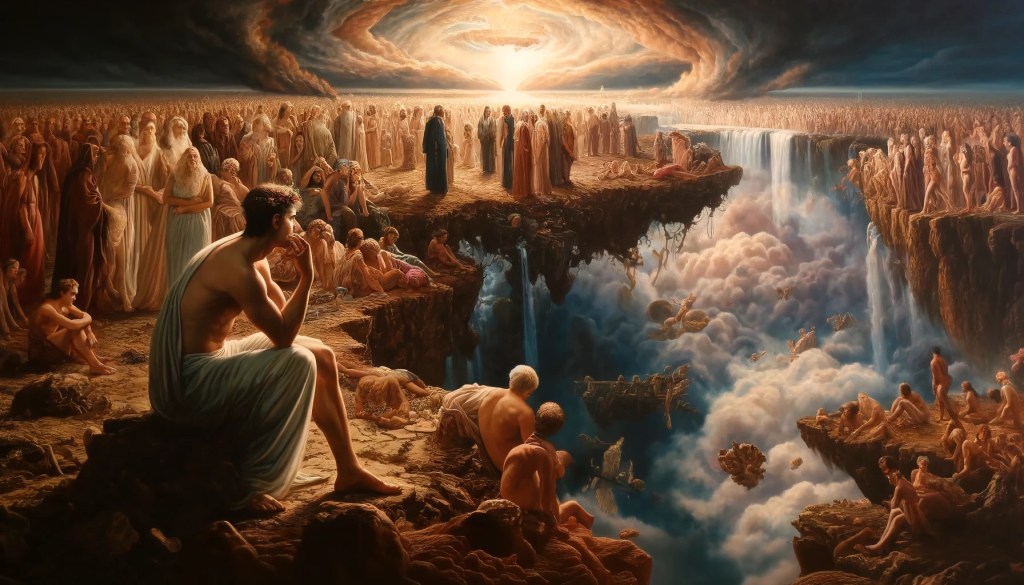
As the centuries unfurled, humanity spread across the face of the Earth, a myriad of tribes and cultures blossoming from the seeds of Adam and Eve. Milo, ever watchful, observed their journeys with a blend of admiration and sorrow, chronicling the evolution of human civilizations as they rose and fell, each epoch marked by both brilliant achievements and profound setbacks.
From the towering ziggurats of Mesopotamia to the vast cities of the Indus Valley, Milo witnessed the ingenuity of humans as they mastered the elements of earth and water, erecting civilizations that harnessed the fertility of river valleys. He marveled at the meticulous planning of grid-like city streets and the grandeur of temples dedicated to gods as myriad as the stars.
In Egypt, along the banks of the Nile, Milo watched as pharaohs commanded the construction of monumental pyramids, tombs destined to stand as eternal testaments to their reigns. The precision of their architecture, aligned with celestial patterns, spoke to humanity’s deep desire to connect with the divine, a pursuit that resonated with Milo’s own celestial nature.

Farther east, in the great expanse of China, Milo observed the development of a civilization that would endure millennia. He saw the laying down of the first stones of the Great Wall, a formidable barrier against marauding nomads from the north. The Chinese sages, whose wisdom he deeply respected, penned philosophies that sought harmony between heaven and earth, philosophies that would shape the moral and social fabric of the nation for generations.
In the Americas, Milo’s gaze followed the rise of the Olmec, the Maya, and later the Aztecs and Incas. He watched them carve cities from the jungle, their pyramids and temples mirroring those of distant lands, revealing a universal human impulse to reach towards the heavens. The rituals and offerings, though sometimes darkened by human sacrifice, underscored the profound human yearning for connection and appeasement of the divine.
Throughout these observations, Milo’s role fluctuated between distant overseer and silent protector. He intervened only when cosmic laws were at stake, gently steering human destiny away from cataclysmic destruction while respecting the free will so integral to the human design.

As empires expanded, Milo witnessed the darker side of human ambition. Wars were waged over territory and resources, leading to suffering and destruction. Yet, in these dark times, Milo also saw the emergence of leaders, prophets, and visionaries who called for justice, peace, and understanding, striving to elevate humanity beyond its baser instincts.
He was there when the Israelites were led from Egypt, their exodus a dramatic saga of faith and freedom. He watched as the laws were given on Mount Sinai, a foundational moment that would deeply influence the spiritual and ethical trajectory of Western civilization.
Milo observed the philosophical flourishes of Greece, where thinkers debated the nature of life and the universe, their ideas a banquet of intellectual exploration that fed the minds of countless generations across disparate cultures.

In Rome, he saw the rise of a republic and then an empire that would come to dominate the Mediterranean world. The legal frameworks and administrative innovations of Rome, many of which endured far beyond the empire’s lifespan, were a testament to the organizational acumen of humanity.
During the spread of Christianity, Milo felt a profound connection to the teachings of Jesus Christ, whose message of love, sacrifice, and redemption echoed the deepest truths of the celestial order. He watched, often with a heavy heart, as these teachings were both embraced and twisted, used to both liberate and subjugate in the centuries that followed.
The Middle Ages brought a tapestry of feudal lords and serfs, castles and knights. In the shadows of monasteries, illuminated manuscripts preserved human knowledge through dark ages, and in the fields, the toil of the common folk shaped the landscape.

As the Renaissance dawned, Milo celebrated the rebirth of art, science, and exploration, humanity’s relentless quest for knowledge rekindling a light similar to the celestial glow of Eden. The discovery of new worlds across the oceans marked a bold expansion of human influence, bringing both collaboration and conflict with indigenous peoples.
Throughout each era, Milo maintained a vigilant watch over humanity’s unfolding story, his celestial reports filled with observations of their creativity, resilience, and the perpetual tension between their higher aspirations and their baser desires.
In every triumph and failure, in every rise and fall, Milo saw the indomitable spirit of humanity striving, sometimes faltering, but always enduring, a perpetual journey towards understanding their place in the cosmos. His silent vigil, though often marked by celestial solitude, was a testament to his unwavering commitment to the Creator’s decree and his deep, abiding love for the human race.
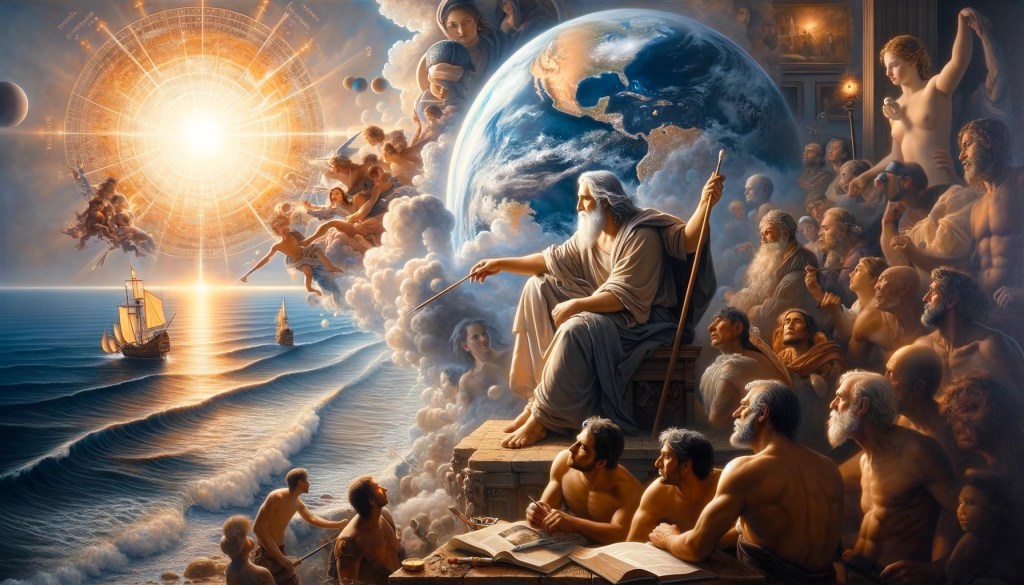
As centuries passed and human civilizations expanded their reach, so too did corruption, violence, and moral decay seep into the heart of humanity. The Earth, once a vibrant testament to divine creation, now bore witness to the darker facets of human nature. The discord that Milo had observed among the celestial beings during Lucifer’s rebellion seemed mirrored now on Earth, a grim reflection of free will gone awry.
In the celestial realm, a council was convened, the celestial beings and the Creator deliberating on the fate of the world. The Earth was sodden with the blood of fratricide and filled with cries of the oppressed, the air thick with the stench of moral rot. The decision was heartrending yet unanimous—a reset was necessary, a divine intervention to cleanse the Earth and offer humanity a fresh start. The method would be a deluge, waters from the heavens and the deep alike converging to purge the world of its iniquity.
Milo, tasked with overseeing this cataclysmic event, felt the weight of his duty with profound solemnity. As the plans were laid out, the Creator revealed a beacon of hope in the impending gloom—the story of Noah, a righteous man who found favor in the eyes of the Lord. Noah and his family were to be the progenitors of a new human chapter, their integrity and faithfulness making them the chosen survivors of the divine storm.

With heavy heart, Milo descended to Earth to watch over the construction of the ark—a vessel that would not only save Noah, his family, and pairs of every living creature but would also symbolize hope amidst despair. He observed Noah, preaching repentance to his neighbors, who mocked the very idea of a flood in a land that had not seen rain for generations. Despite the scorn, Noah’s faith wavered not, his hands working tirelessly as he followed the divine blueprint for the ark.
As the day appointed for the flood drew near, Milo watched as the animals, led by a celestial impulse, made their way to the ark in pairs. The sight of lions lying down with lambs, of doves perching beside ravens, all entering the sanctuary of the ark, was a poignant reminder of Eden’s lost peace.
Then came the rains, gentle at first, as if the heavens themselves were reluctant to unleash their full fury upon the Earth. But soon, the skies opened with a vehemence that shook the foundations of the world. Water surged from the deep, rivers broke their bounds, and the seas swelled like wounds bursting open. Milo, from his vantage point above, watched as the landscape was swallowed by roiling waters, mountains submerged, and cities erased.

Throughout the forty days and nights that the rains lasted, Milo remained close to the ark, his presence a silent sentinel amid the storm’s chaos. Inside, Noah and his family faced not only the fear of annihilation but the burden of being humanity’s remnants, their survival a heavy responsibility.
When the waters finally receded, revealing the peaks of mountains like islands in a vast ocean, Milo felt both relief and sorrow. The Earth was cleansed, but the cost was etched into the very fabric of his celestial being. He observed as Noah opened the ark’s window, releasing a dove to find land, its return with an olive leaf a symbol of new beginnings and enduring hope.
The repopulation of the Earth was slow and fraught with challenges, but Milo watched over Noah’s descendants as they spread across the newly blank slate of a world. The covenant God made with humanity, symbolized by a rainbow spanning the sky, was a promise of never again destroying the Earth with a flood. This covenant was a testament to divine mercy, a balance between justice and compassion that Milo held dear.

In the centuries that followed, the tale of the Great Flood became a narrative of caution and renewal, etched into the collective memory of all civilizations that rose from the survivors. Milo, in his reports back to the celestial realm, reflected on the resilience of life and the indomitable spirit of humanity to rise from adversity.
As he continued his guardianship, Milo was ever mindful of the delicate balance between divine intervention and human agency, his vigilance a constant reminder of the lessons learned from the flood—of justice, mercy, and the hope that even in the darkest times, there is a possibility for renewal and redemption.
After the flood, as humanity began to flourish and spread across the newly cleansed earth, a collective ambition grew among the descendants of Noah. They sought not only to rebuild their lives but also to etch their names into the annals of history through a monumental endeavor. This ambition culminated in the construction of the Tower of Babel, an edifice intended to reach the heavens—an act driven by pride and the desire to make a name for themselves, lest they be scattered across the world.
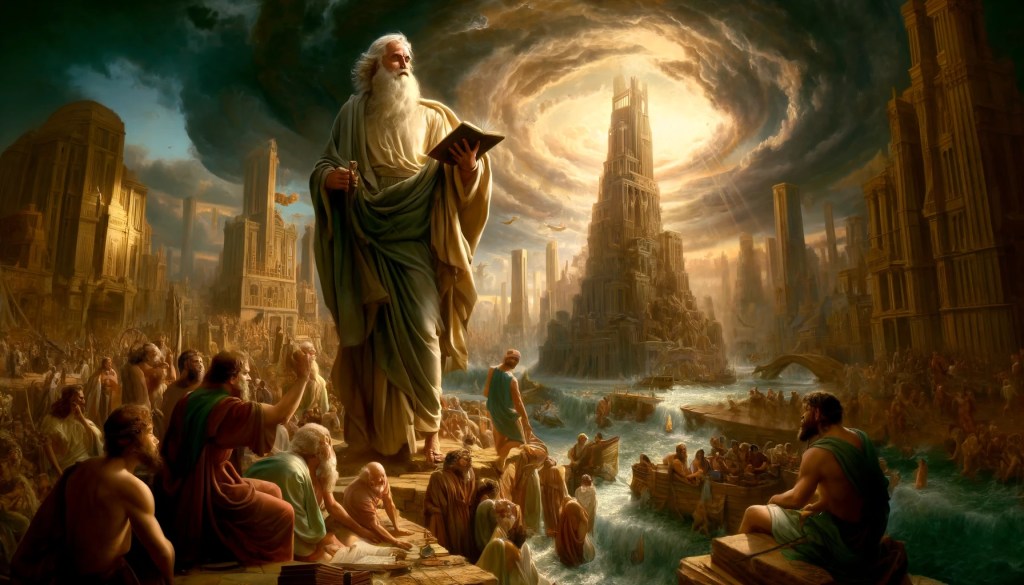
Milo watched as men and women, unified by a single language and a shared vision, gathered on the plains of Shinar. They harnessed technology and resources, forging bricks and bitumen, materials that would enable their structure to pierce the skies. The tower rose from the earth day by day, an imposing pillar of human ingenuity and collective effort that seemed to defy the natural order.
As the tower’s height grew, so did the hubris of its builders. Their initial intent to survive and thrive morphed into a quest for glory and dominance. The construction site buzzed with activity, a cacophony of voices that sang praises of human achievement, while whispers of doubt and fear were drowned out by the clamor of construction.
Milo observed all of this with a deepening concern. The unity of humanity, while remarkable, was skewed by arrogance and the denial of their intrinsic dependence on the divine. He saw in their endeavor echoes of Lucifer’s rebellion—a parallel in the desire to ascend beyond their ordained place and challenge the boundaries set by the Creator.

The heavens responded not with immediate wrath but with a calculated intervention that would realign humanity’s path without annihilating its spirit. The Creator, in His wisdom, decided to confound their language, not merely to punish but to protect them from the consequences of their unchecked ambition.
Milo was present when this divine act took place. One morning, as the workers arrived at the site, the air thick with the dust of construction, a sudden change swept over them. Words that once held meaning among all now sowed confusion. Speech became a babel of unintelligible sounds as every individual suddenly found themselves speaking a language unknown to their peers.
The effect was instantaneous and chaotic. Commands issued at the tower’s base turned into nonsensical babble by the time they reached the workers above. Confusion bred frustration; frustration turned to anger. The unity that had been their strength fractured into myriad shards of incomprehension. Groups formed among those who could understand each other, and suspicion took root where misunderstanding flowered.

The construction of the tower stalled, inevitably doomed by the barrier of language. The people, unable to cooperate as before, began to disperse, driven by a divine impulse to populate the earth as originally intended. The tower stood, half-completed, a monument not to human glory but to their limitations and the complexities of divine will.
As the people spread across the globe, they carried with them the diverse tongues instilled by the Creator. Cultures, customs, and civilizations blossomed in a rich tapestry of human diversity. Each group adapted to different lands and challenges, their stories and languages evolving independently.
Milo, in his celestial duties, followed these migrations, witnessing the emergence of diversity as a source of strength and beauty rather than division. He marveled at the resilience of humanity, their ability to find home and harmony in even the most challenging environments.
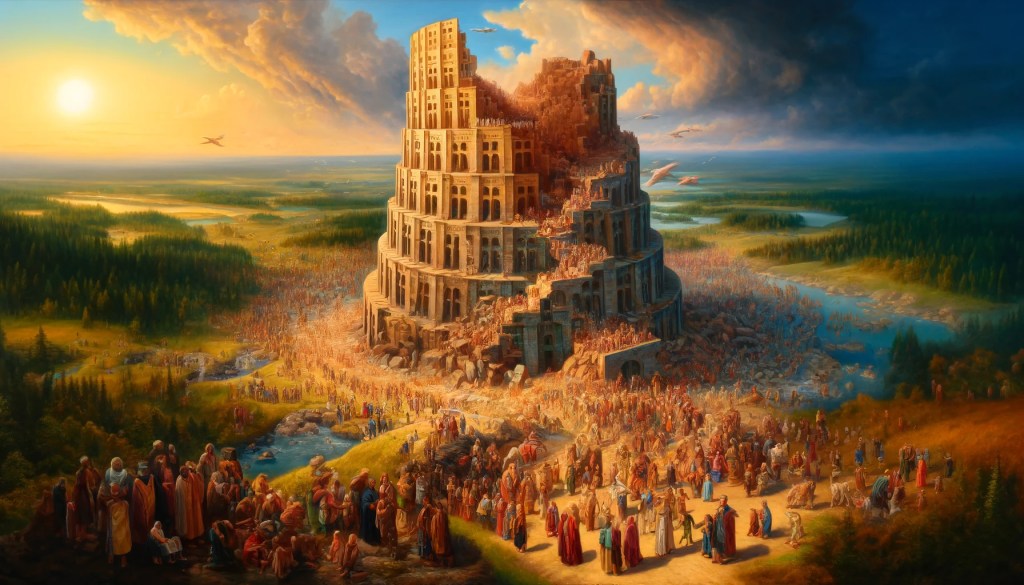
Yet, the lesson of Babel lingered in the collective memory of humankind. It served as a reminder of the dangers of pride and the unyielding nature of divine mandates. For Milo, it was a reaffirmation of his role as a guardian—a reminder to guide humanity subtly, influencing them towards humility and reminding them of their place within the grand cosmic order.
In the aftermath of Babel, Milo continued to observe and protect humanity as they grew and spread across the world, their languages and stories as varied as the stars in the sky. Each human narrative was a thread in the broader tapestry of creation, each culture a reflection of the Creator’s love for diversity and innovation. Through it all, Milo remained a silent witness, a guardian angel committed to the stewardship of a complex, vibrant, and profoundly human world.
As the descendants of Noah spread across the earth, diversifying in culture and language in the aftermath of Babel, a new chapter unfolded with the call of Abram, a man destined to become a foundational figure in the history of humanity. Milo, the silent guardian of human affairs, turned his attention to this lone figure, whose faith and obedience would set a course for generations to come.

Abram lived in Ur of the Chaldeans, a city thriving with trade and idolatry, reflective of a civilization that had strayed far from the memory of the Creator’s direct interventions in human history. Yet in this environment, Abram’s heart was stirred by a sense of divine purpose, a whisper of something greater than the visible gods of his people.
The call came to Abram not as a thunderous proclamation but as a clear, unmistakable voice in the quiet of his spirit. “Go from your country, your people and your father’s household to the land I will show you,” it commanded. This directive was both a test and a promise, a call to leave everything familiar behind in exchange for an inheritance yet unseen.
Milo watched as Abram wrestled with the implications of this call. It was not merely a physical journey that was required of him but a spiritual leap into a covenant that would define his descendants forever. With faith as his compass, Abram chose obedience, stepping into the unknown, his wife Sarai by his side, along with his nephew Lot.

As Abram journeyed, Milo observed the challenges and revelations that marked his path. Arriving in Canaan, the land promised to him by the Creator, Abram built altars and called upon the name of the Lord, marking the landscape not only with his footsteps but with acts of worship and proclamation of his God’s sovereignty.
Yet, the journey was fraught with trials. A famine led Abram to Egypt, where fear compromised his integrity as he deceived Pharaoh about Sarai’s identity to protect himself. Despite this, the Creator’s protection remained over Abram, a testament to the unmerited favor that defined this covenant. Pharaoh, struck by plagues, soon realized the truth and sent Abram away, enriched with livestock and goods, but chastened in spirit.
Returning to Canaan, Abram’s faith was further tested and refined. Conflicts over land and water with Lot’s herdsmen necessitated a separation. Milo noted Abram’s generosity and trust in the Creator’s provision as he allowed Lot to choose his portion of the land first, embodying the principles of peace and deference that would become hallmarks of his character.

In these formative years, the Creator reaffirmed His promises to Abram in multiple encounters, each deepening Abram’s understanding and commitment. The most profound of these was the covenant ceremony, where the Creator made an everlasting covenant with Abram, promising that his descendants would be as numerous as the stars in the sky. During this ceremony, Abram fell into a deep sleep, and a terrifying darkness enveloped him, signifying the severe trials his descendants would endure.
Milo, witnessing this solemn pact, saw the smoking fire pot and blazing torch pass between the pieces of sacrificed animals—an ancient ritual signifying an unbreakable bond. This visual manifestation of the covenant left no doubt about the Creator’s serious commitment to Abram and his descendants.
As years passed, the promise of an heir seemed elusive, testing Abram’s faith further. Sarai, barren and growing impatient, offered her servant Hagar to Abram, resulting in the birth of Ishmael. This act, though borne out of desperation, introduced conflict and sorrow into Abram’s household, a reminder of the complications that arise when human schemes preempt divine timing.

Despite these trials, Abram’s relationship with the Creator grew deeper. In a defining moment, his name was changed from Abram to Abraham, signifying his transformation from “exalted father” to “father of many nations.” Similarly, Sarai became Sarah, and the promise of a son through her was reiterated, a miracle that defied their old age.
When Isaac, the child of promise, was finally born to Abraham and Sarah, Milo saw it as a fulfillment of divine faithfulness, a joyous culmination of decades of waiting and a beacon of hope for future generations. Abraham’s journey from a called wanderer to the patriarch of a chosen people was marked by moments of faltering and faithfulness, each step watched over by celestial beings like Milo, who chronicled the human capacity for faith and the complexity of divine-human interactions.
Through Abraham’s life, Milo gleaned profound insights into the dynamics of faith, obedience, and the painful yet necessary growth that comes from walking in alignment with the divine will. His silent vigil over Abraham and his descendants would continue, each generation weaving new threads into the rich tapestry of a covenantal relationship that shaped much of human history.

Centuries after the covenant with Abraham, the descendants of Isaac, now a numerous people known as the Israelites, found themselves in bondage in Egypt. Their growth and increasing numbers had threatened the Egyptian Pharaoh, who imposed harsh slavery upon them to curb their strength and break their spirit. This chapter of suffering was not unseen by the celestial beings; Milo, the silent guardian, watched over the Israelites, awaiting the moment when divine justice would manifest to deliver them from their plight.
The cries of the Israelites reached the heavens, a sorrowful chorus that echoed through the celestial realms. The Creator, moved by their suffering, prepared to intervene in a demonstration of power and liberation that would be remembered throughout the ages of mankind. To accomplish this, He chose Moses, a Hebrew raised within the Egyptian royal family, yet exiled for an act of defiance against the oppression of his people.
Milo observed Moses in the desert of Midian, a man torn between his past comforts in Egypt and the harsh realities of his true heritage. When the Creator appeared to Moses in the burning bush on Mount Horeb, Milo was there, watching the flames that did not consume the bush, a symbol of the enduring and passionate call to deliverance that would not destroy Moses but empower him.

“Go,” the Creator commanded Moses, “and bring my people out of Egypt.” The task was daunting, and Moses hesitated, plagued by doubts and fears. Yet, the assurances from the Creator and the appointment of his brother Aaron as his spokesman fortified his resolve. Milo, in his role as a celestial overseer, prepared to witness and record the series of divine interventions that would follow.
As Moses and Aaron confronted Pharaoh, demanding the release of the Israelites, Milo watched each refusal harden Pharaoh’s heart further. With each denial, the Creator unleashed plagues upon Egypt, each a marvel of natural forces harnessed as instruments of divine will: waters turning to blood, swarms of frogs, lice, flies, pestilence, boils, hail, locusts, and darkness so profound it could be felt.
Milo chronicled these events, noting not only their impact on Egypt but also the growing faith and unity among the Israelites, who witnessed these signs and wonders. The tenth and final plague, the death of the firstborn in every Egyptian home, was the most grievous, a somber reminder of the cost of Pharaoh’s stubbornness. The Israelites, protected by the blood of the lamb smeared on their doorposts, were spared, marking the first Passover, a celebration of life and deliverance that would define their identity forever.

With a heavy heart, Pharaoh finally relented, and the Israelites fled Egypt, a multitude moving as one towards a promised freedom. Milo observed their hurried departure, the mixed emotions of fear, relief, and exhilaration mingling among them as they crossed the desert towards the Red Sea.
At the Red Sea, trapped between the water and the approaching Egyptian army, the Israelites despaired. Yet, in their darkest moment, the Creator intervened through Moses, who stretched out his staff over the sea. Milo watched in awe as the waters parted, creating a path of dry land flanked by walls of water—a miracle of divine power and a testament to the Creator’s protection of His covenant people.
The Israelites crossed safely, but when the Egyptians pursued, the waters returned, swallowing chariots, horses, and soldiers, a tragic end to those who would not yield to the Creator’s will. This event, a dramatic climax to the exodus, was etched into the memory of every surviving Israelite, a story of deliverance that would be passed down through generations.

As the Israelites journeyed towards Mount Sinai, where they would receive the Law and further instructions from the Creator, Milo continued his vigil. He observed Moses ascending the mountain, disappearing into a cloud of divine presence that settled atop Sinai. The giving of the Law, including the Ten Commandments, was a foundational moment, not just for the Israelites but for the moral and spiritual order of future civilizations.
Throughout this period, Milo recorded every detail, from the quakes of the mountain to the fear and reverence of the people below. These laws, inscribed on stone tablets by the Creator’s own hand, were not mere rules but the forming of a covenant that reiterated the special relationship between the Creator and the Israelites.
Milo’s accounts of these events highlighted the themes of justice, mercy, and the relentless pursuit of the Creator to guide and shape His people into a nation that would uphold His values and reflect His love to the world. The exodus was not just an escape from physical bondage but a journey towards a spiritual and communal identity, guided by divine laws and safeguarded by celestial oversight.

As the Israelites encamped at the base of Mount Sinai, a profound sense of anticipation and solemnity permeated the air. The dramatic escape from Egypt and the miraculous crossing of the Red Sea had prepared them for a significant divine encounter. Milo, as their celestial guardian, sensed the gravity of the moment—a pivotal point in their covenant relationship with the Creator.
Moses ascended Mount Sinai, disappearing into a dense cloud that signified the divine presence. The mountain quaked, thunder roared, and lightning flashed, manifestations of divine power that instilled awe and fear in the hearts of the Israelites. Milo observed from above, his celestial perspective providing him with both a view of the physical phenomena and an insight into their spiritual significance.
The giving of the Law, particularly the Ten Commandments, was not merely a legalistic imposition but a foundational act of grace, designed to guide the Israelites in living a life that reflected their unique relationship with the Creator. These laws were principles of life that, if followed, would set them apart as a holy nation, a light to the surrounding nations entrenched in idolatry and moral decay.

Milo watched as Moses remained on the mountain for forty days and nights, a period of divine communion during which the tablets of stone were inscribed by the finger of God. These tablets were tangible symbols of the covenant, containing the essence of the Creator’s expectations for His chosen people.
The first commandment, “You shall have no other gods before Me,” established the exclusivity of their worship, a direct challenge to the polytheistic practices rampant in the ancient world. Milo understood this as foundational, for true freedom and identity were rooted in acknowledging and serving the one true Creator.
The prohibition against idolatry, the second commandment, reinforced this concept, steering the Israelites away from the tangible representations of gods that dominated the religious landscapes of neighboring cultures. This law sought to cultivate a spirituality based on faith and truth, rather than on the visible and often manipulative practices of idol worship.

As the commandments unfolded, addressing honor to parents, the sanctity of life, marital fidelity, and the rights of property, Milo saw them as divine wisdom for creating a just and compassionate society. Each law was interwoven with the principles of respect, responsibility, and relational integrity.
The Sabbath commandment, in particular, underscored a rhythm of work and rest, a weekly reminder of the Creator’s own rest after the work of creation, and an invitation for the Israelites to remember their liberation from the relentless labor in Egypt. This law was not only about rest but was also a call to reflection and spiritual renewal.
Milo noted the mixed reactions among the Israelites. While many trembled in awe and renewed their commitment to follow the Creator’s path, others struggled with doubt and fear, their faith still fragile from the centuries of enslavement and the hardships of their recent journey.

When Moses finally descended, his face radiant with the glory of his divine encounter, he presented the tablets to the people, declaring them the words of the covenant. The people’s response, a resounding commitment to obey all that the Creator had commanded, marked a moment of collective consecration.
However, the subsequent incident with the golden calf revealed the volatile nature of human fidelity. As Moses interceded for the people, his role as a mediator was highlighted—a foreshadowing of the need for continual divine intervention in human affairs. Milo recorded these events meticulously, understanding that they demonstrated the complex dynamics of divine justice tempered with mercy.
Throughout these events, Milo’s role transcended mere observation. He acted as an intercessor, conveying the deep concerns and prayers of the Israelites to the celestial realms, advocating for guidance and patience in their spiritual and communal development.

The giving of the Law at Sinai, therefore, was a profound act of divine pedagogy, teaching the Israelites not only how to live but how to be a people of the Creator. It set a moral and spiritual framework that would challenge and shape their identity across generations.
As the Israelites continued their journey, the laws given at Sinai would test and refine them, a process Milo witnessed with a blend of celestial insight and empathetic concern. His records, imbued with both celestial wisdom and an understanding of human frailty, formed a crucial narrative of human history, illustrating the ongoing need for divine guidance and the persistent struggle between human will and divine intention.
The era following the giving of the Law was marked by a tumultuous cycle of judges who led the Israelites through periods of prosperity and decline, each cycle a testament to the struggle between divine fidelity and human fallibility. As the era of judges waned, the clamor for a monarchial form of governance rose among the Israelites. They desired a king, a tangible leader who would not only govern them with justice but also lead them in battles against their ever-threatening neighbors. This request was brought before the prophet Samuel, and it was met with divine reluctance; for the Creator knew the hearts of men, and how easily they replaced divine sovereignty with human authority.

Milo, from his celestial vantage point, watched as Saul was anointed the first king of Israel. His reign began with promise and potential. Saul, a man of impressive stature and charisma, was initially humble and obedient to the divine commands. However, as his reign progressed, Saul’s insecurities and impulsive decisions led to his downfall. His failure to fully obey divine instructions during the war with Amalek marked a turning point, leading to the divine rejection of his kingship.
Milo observed the rise of David, a shepherd boy chosen by God for his heart after His own. David’s ascent from obscurity to prominence was marked by his anointment by Samuel, his victory over Goliath, and his tumultuous relationship with Saul, who, driven by jealousy, sought to kill him multiple times. Despite these challenges, David maintained a character of respect and patience, sparing Saul’s life on several occasions, demonstrating a deep reverence for the anointed king, regardless of Saul’s faults.
David’s reign as king was characterized by significant military conquests, expansion of Israelite territory, and political consolidation. Yet, it was his personal failures, notably his adultery with Bathsheba and the murder of her husband Uriah, that revealed the complexities of human nature. Despite these moral failings, David’s genuine repentance and poetic lamentations in the Psalms provided profound insights into the human condition, resonating with Milo’s understanding of human frailty and the possibility of divine forgiveness.

Solomon, David’s son, succeeded him, and his reign was marked by unprecedented wisdom and wealth. The construction of the Temple in Jerusalem was a highlight of Solomon’s reign, fulfilling his father David’s dream of building a permanent dwelling place for the Ark of the Covenant. However, Solomon’s later years were marred by idolatry and excess, influenced by his many foreign wives, leading to a divided heart and kingdom.
Upon Solomon’s death, the kingdom split into the northern kingdom of Israel and the southern kingdom of Judah. This division weakened their collective strength and made them vulnerable to surrounding nations. Milo watched as both kingdoms repeatedly oscillated between periods of idolatry and reforms, with prophets like Elijah, Isaiah, and Jeremiah calling the people back to the covenant with God.
The northern kingdom of Israel eventually fell to the Assyrian Empire, its people exiled and scattered, a fate that Milo noted with sorrow, observing how quickly they had forsaken the laws given to their ancestors. The southern kingdom of Judah lasted longer, experiencing a brief revival under kings like Hezekiah and Josiah, but eventually, it too succumbed to idolatry and injustice, culminating in the Babylonian captivity.
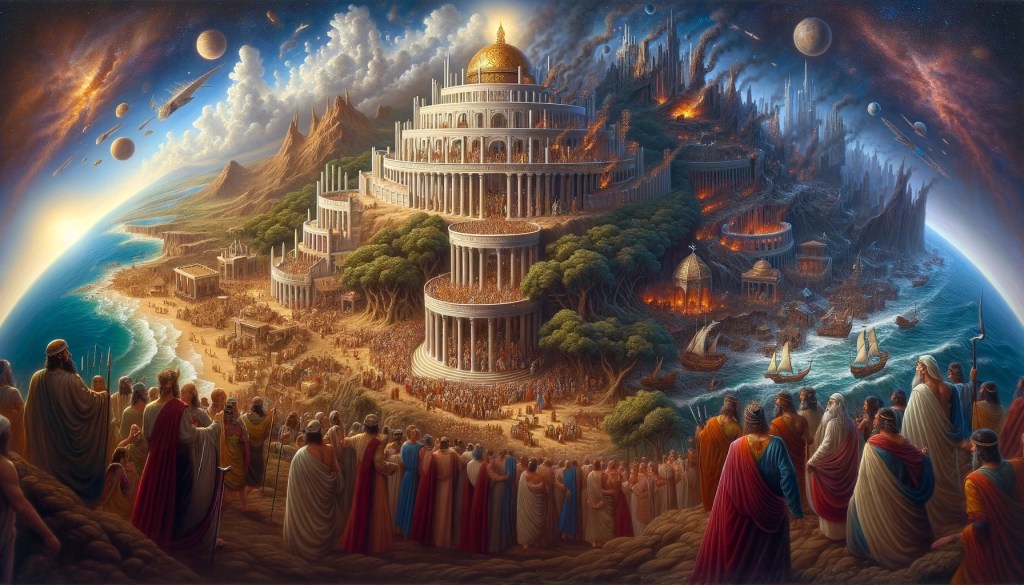
The siege and destruction of Jerusalem by Nebuchadnezzar was a devastating moment, observed by Milo with a heavy heart. The Temple Solomon built was razed, the city walls were broken down, and the people were led away into Babylon, where they hung their harps upon the willows, lamenting the loss of their land and freedom.
During the exile, Milo’s role shifted subtly from observer to comforter, his presence a silent whisper among the captives, reminding them of the prophecies that spoke of eventual return and restoration. He witnessed the faithfulness of individuals like Daniel, who, even in a foreign land, maintained their integrity and worship of the Creator, influencing Babylonian rulers and setting examples of devout adherence to divine law.
This period of exile was not just a punishment but a time of purification and reflection for the Israelites, a necessary pause that allowed them to reconsider their priorities and rekindle their commitment to the covenant. Milo recorded these lessons with a deep understanding that the cycles of human governance, with their rises and falls, were not merely historical footnotes but pivotal moments that shaped the spiritual and moral fiber of the people.

As the prospect of return to Jerusalem became tangible through the decrees of Persian kings like Cyrus, who was moved by divine prompting to allow the rebuilding of the Temple, Milo prepared to observe and record the next chapter of restoration and rebuilding. The cycles of rise and fall had imparted lessons of resilience, the importance of divine guidance, and the eternal hope that even in the darkest times, restoration was possible through repentance and divine mercy.
The celestial anticipation surrounding the birth of Christ was profound and filled with cosmic significance. After centuries of prophets foretelling His coming, the moment had arrived—a pivotal point in both human and celestial history. Milo, who had witnessed the ebbs and flows of human empires and the spiritual journey of God’s people, understood the incarnation as a transformative event that would bridge the divine and the human in an unprecedented way.
As the world carried on unaware, the heavens prepared for a grand announcement. The alignment of celestial bodies marked the coming of something extraordinary. Stars that had shone indifferently over countless human affairs now took on new positions, heralding the arrival of the King of Kings.
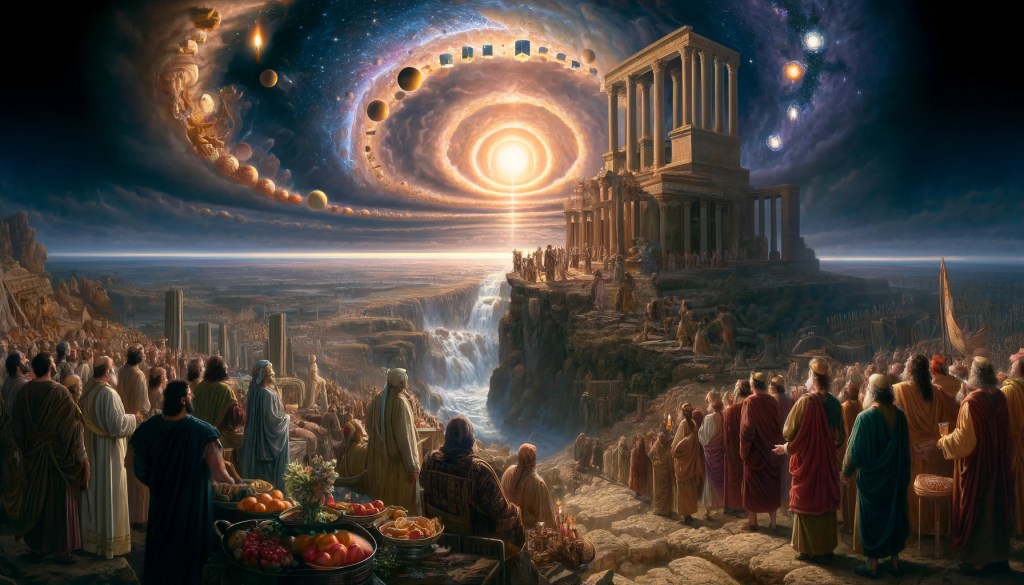
In a humble setting, far removed from earthly palaces, the divine chose to make His entrance into human history. Mary, a young woman of deep faith and obedience, chosen by God for her heart’s purity, became the mother of Jesus. Joseph, her betrothed, a man of integrity and kindness, accepted the divine will with a quiet strength that belied the societal challenges of their unexpected pregnancy.
Milo observed the night of Jesus’ birth with a reverence that stirred his celestial essence. In Bethlehem, under a starlit sky, Jesus was born in a stable—a place symbolic of the humility and simplicity that would mark His earthly ministry. The choirs of angels, usually unseen and unheard by human ears, filled the heavens with glorious music, singing “Glory to God in the highest, and on earth peace, goodwill toward men.”
Shepherds in nearby fields, witnesses to this celestial concert, were enveloped in a heavenly light that turned their night into day. Fear gave way to awe as the angelic message directed them to the newborn Savior, wrapped in swaddling clothes and lying in a manger. Their visit to the stable confirmed the truth of the angelic proclamation, and they left as the first human heralds of the divine birth, spreading the news with joy and wonder.

Wise men from the East, scholars of the stars, interpreted the celestial signs and embarked on a journey that would lead them to worship the King of the Jews. Their gifts of gold, frankincense, and myrrh were laden with prophetic significance, each symbolizing aspects of the Messiah’s identity and destiny—kingly authority, priestly role, and a sacrificial death.
Milo watched as these events unfolded, each detail a thread in the grand tapestry of redemption being woven before his eyes. The incarnation was not merely a theological event but a personal one, as God Himself entered into the very world He had created, subject to its pains and limitations, yet without sin.
Throughout Jesus’ childhood, Milo continued his watchful guardianship. Each step of growth, each word spoken by Jesus, even at a young age, reflected both His divine nature and His genuine humanity. The visit to the temple in Jerusalem when Jesus was twelve revealed His deep understanding of His identity and mission, as He engaged with religious teachers, both listening and asking questions that belied His youth.

As Jesus grew into manhood and began His public ministry, Milo observed the fulfillment of ancient prophecies through His teachings, miracles, and interactions with the marginalized of society. The message Jesus brought was radical—a kingdom not of this world, but rooted in love, justice, and spiritual truth.
The reactions were mixed—while many followed, drawn by His words and works, others, threatened by His challenges to their authority and understanding, plotted against Him. Throughout, Jesus remained focused on His mission, a path that Milo knew would lead to the ultimate sacrifice.
The incarnation, thus, was a mystery enveloping not just the divine taking on human flesh but also the profound implications of this act. Through Jesus, the broken relationship between humanity and the Creator would be offered healing. Through His life and teachings, the kingdom of Heaven was brought near, accessible not through works but through faith in Him.

Milo’s documentation of these events was meticulous, capturing not only the historical and cultural nuances but also the spiritual dynamics at play. His records would serve as celestial testaments to the divine love and mercy demonstrated through the life of Christ, a love that reached its climax in the events of the crucifixion and resurrection, forever altering the spiritual trajectory of humanity.
Milo’s observations of Jesus’ ministry were imbued with a deep understanding of its spiritual significance. Each moment and movement of Jesus was a revelation, as He unveiled the nature of the Kingdom of God through parables, miracles, and personal interactions that transcended the ordinary.
As Jesus traveled through Galilee, Judea, and beyond, Milo noted how He brought a message of hope and renewal that resonated profoundly with those who were marginalized and oppressed. Jesus’ words were not just teachings; they were manifestations of divine truth, spoken with an authority that challenged traditional interpretations of the Law and pointed to a deeper, more intimate relationship with God.
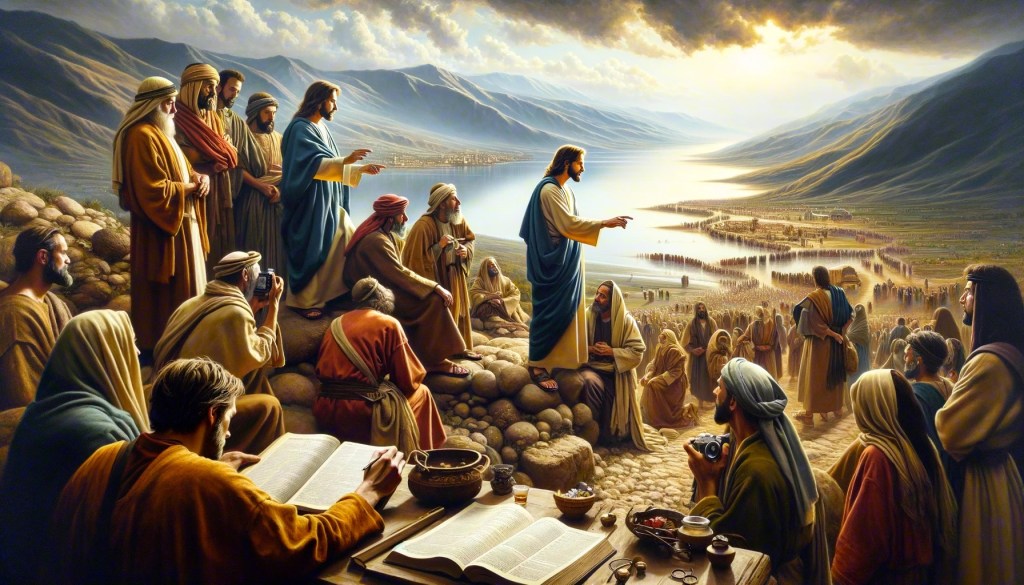
Milo marveled at the Sermon on the Mount, where Jesus articulated the Beatitudes—blessings that inverted worldly values, promising the kingdom of heaven to the poor in spirit, comfort to those who mourn, and the earth to the meek. These teachings laid the foundation for a new covenant, where inner purity and love for others overshadowed ritualistic compliance and superficial piety.
The miracles Jesus performed were signs of the Kingdom’s power breaking into the world. Milo witnessed Jesus healing the sick, giving sight to the blind, and mobility to the paralyzed, each act challenging the natural order and revealing divine compassion. Notably, the feeding of the five thousand illustrated Jesus’ ability to meet human needs supernaturally, pointing to Him as the true bread of life.
Milo was particularly moved by Jesus’ interaction with individuals often shunned by society. The Samaritan woman at the well, for example, experienced a personal conversation that transformed her life. Jesus’ knowledge of her past and His offer of “living water” led to a profound revelation of His identity as the Messiah. This encounter, like many others, highlighted Jesus’ radical inclusion, extending grace and truth beyond traditional ethnic and religious boundaries.

The raising of Lazarus from the dead stood as a poignant demonstration of Jesus’ power over life and death, a theme that would reach its zenith in His own resurrection. Milo, understanding the celestial implications, noted how this miracle foreshadowed the ultimate victory over death, offering hope to all of humanity for eternal life.
Throughout His ministry, Jesus also emphasized the importance of faith, illustrated poignantly when He calmed the storm on the Sea of Galilee. His disciples’ terror, juxtaposed with His calm command, underscored their nascent understanding of His divine nature. “Why are you so afraid? Do you still have no faith?” His questions pierced the heart of human fear and doubt, pointing toward a trust in God that transcends understanding.
Milo saw the opposition to Jesus grow as His fame spread. The Pharisees and Sadducees, threatened by His popularity and challenges to their authority, plotted to undermine Him. Each conflict, whether over Sabbath laws or His association with sinners, underscored the tension between human religious constructs and the liberating truth Jesus offered.
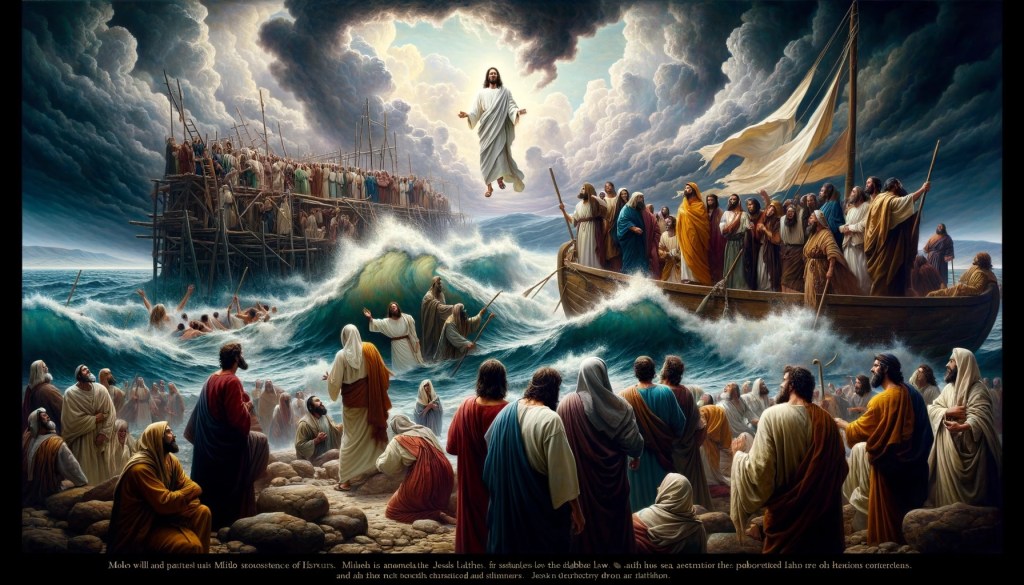
As Jesus approached Jerusalem in the final week of His life, Milo sensed the impending climax of His earthly ministry. The triumphal entry, marked by crowds shouting “Hosanna,” contrasted sharply with the somber understanding that Jesus had of His impending sacrifice. This moment of mixed joy and sorrow encapsulated the dual reality of Jesus’ mission—celebrated as a king, yet walking toward suffering and death for the sake of humanity.
The cleansing of the Temple, where Jesus overturned the tables of the money changers, was a potent declaration of His zeal for true worship, untainted by exploitation and hypocrisy. It was a physical and symbolic act that reclaimed the house of prayer for the nations and indicted the religious leaders’ corruption.
Milo’s reflections on Jesus’ final teachings to His disciples emphasized the deep love and care Jesus had for His followers, encapsulated in the poignant imagery of the vine and branches, teaching them about abiding in Him as the only source of true life.

As the plot to arrest Jesus unfolded, Milo’s celestial perspective grasped the full tragedy and triumph of the upcoming crucifixion. He understood this was the necessary path, foretold by prophets, which would break the power of sin and death. Jesus’ forthcoming sacrifice was the fulcrum on which the fate of humanity would pivot—offering reconciliation with God and inaugurating a new era of the Spirit.
Throughout these observations, Milo’s chronicles conveyed not just the historical reality of Jesus’ ministry but its cosmic ramifications—the weaving of a divine tapestry that would draw all of creation back to its rightful relationship with the Creator. Each word recorded was imbued with the gravity and glory of what was being unveiled: the Kingdom of God, near at hand, accessible through the person of Jesus Christ.
The crucifixion of Jesus Christ stands as one of the most profound paradoxes in human history, encapsulating the utmost horror and the deepest beauty within a single event. For Milo, the guardian of humanity’s saga, this moment was not just a historical occurrence but a cosmic event that realigned the spiritual axis of the universe.
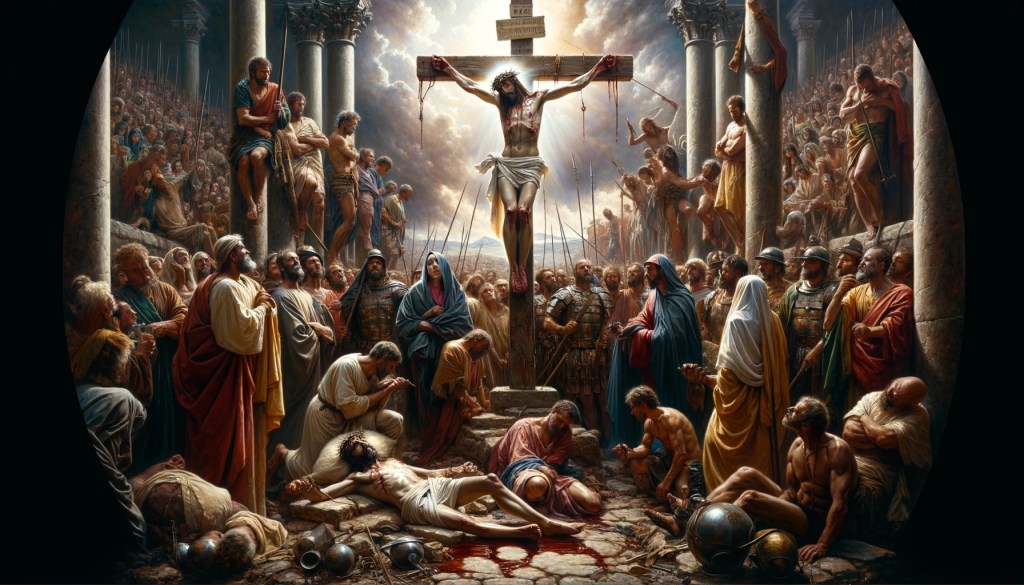
As the events leading to the crucifixion unfolded, Milo observed with a heavy heart. Jesus, after sharing a final meal with His disciples and imparting crucial last teachings, entered the Garden of Gethsemane. There, the weight of the impending sacrifice pressed deeply upon Him. Milo watched as Jesus, in a display of profound vulnerability and humanity, fell to the ground in anguished prayer, sweating drops of blood. “Father, if you are willing, take this cup from me; yet not my will, but yours be done,” He pleaded. This moment of raw anguish revealed the depth of Jesus’ commitment to fulfilling His mission, a mission rooted in divine love and justice.
The betrayal by Judas, one of His own disciples, marked the beginning of a rapid and brutal progression of events. Arrested under the cover of night and abandoned by His friends, Jesus faced a series of mock trials that flaunted legal norms and justice. The religious leaders, consumed by jealousy and fear, manipulated the proceedings to ensure His condemnation. Meanwhile, the Roman governor Pontius Pilate, a man caught between the expediency of politics and the stirrings of his own conscience, ultimately handed Jesus over to be crucified, succumbing to the pressure of the crowd.
Milo observed the scourging and mocking of Jesus with profound sorrow. Roman soldiers, instruments of the empire’s cruel might, whipped Jesus with a flagrum, a whip embedded with pieces of bone and metal. They draped Him in a purple robe and pressed a crown of thorns onto His head, mocking His claim to kingship. Despite this, Jesus endured the mockery and pain with a silence that was itself a powerful testimony to His strength and sovereignty.

As Jesus was led through the streets of Jerusalem, bearing the heavy wooden cross on His scourged back, Milo saw the horror of humanity’s capacity for cruelty juxtaposed with the beauty of divine love. Simon of Cyrene was compelled to help carry the cross, a symbol of the burden-sharing that Jesus’ teachings exemplified. Women along the path wept for Him, and to them, He spoke of greater woes to come, pointing beyond His immediate suffering to the future tribulations of Jerusalem.
Upon reaching Golgotha, the Place of the Skull, Jesus was crucified between two thieves. The horror of crucifixion, a method designed to maximize pain and prolong death, was evident in every hammer blow that drove the nails through His hands and feet. As He was lifted up, the skies darkened, reflecting the somber reality unfolding below. Despite His agony, Jesus’ concern for others persisted; He prayed for His executioners, “Father, forgive them, for they do not know what they are doing,” and ensured care for His mother by entrusting her to the disciple John.
Milo, witnessing these events, recorded the mixture of divine mercy and human brutality. The sign above Jesus’ head declared mockingly in multiple languages, “This is the King of the Jews,” a title whose truth far exceeded the scope of earthly understanding. The leaders scoffed, the soldiers gambled for His garments, and the crowd watched, a panorama of human responses to the divine sacrifice occurring before them.

In His final moments, Jesus cried out, “Eli, Eli, lema sabachthani?”— “My God, my God, why have you forsaken me?”—a poignant expression of feeling abandoned, quoting Psalm 22, which foretold the suffering of the Messiah. His subsequent declaration, “It is finished,” marked the completion of His earthly mission, the fulfillment of centuries of prophecy, and the consummation of the sacrificial act of redemption.
As Jesus gave up His spirit and the earth shook, the veil of the Temple was torn in two from top to bottom, signifying the removal of the barrier between God and humanity. The centurion overseeing the execution, struck by the events, exclaimed, “Truly this was the Son of God!” acknowledging the divine nature of the man he had just crucified.
The crucifixion, as Milo understood and recorded, was not the end but a pivotal moment in divine history. It represented the ultimate sacrifice for sin, the restoration of broken relationships, and the opening of a new covenant between God and all of humanity. The beauty of this sacrifice lay in its power to transform hearts and lives, a theme that would echo through the resurrection, affirming the victory of life over death and hope over despair.

The darkness of the crucifixion gave way to the brilliance of the resurrection, a pivotal moment in human history that affirmed Jesus’ victory over death and His promise of eternal life. For Milo, this was not merely a continuation of his observations but a profound confirmation of the divine plan’s fulfillment, the ultimate vindication of righteousness and mercy that resonated throughout the cosmos.
On the third day after Jesus’ death, the early morning found the tomb guarded by Roman soldiers and sealed with a large stone. Yet these physical barriers could not contain the power of the divine. As dawn broke, the earth shook violently, and an angel of the Lord descended, his appearance like lightning, his clothes white as snow. The guards were so shaken by fear that they became like dead men.
The angel rolled back the stone, not to let Jesus out, but to reveal that He was no longer there—He had risen. Women, followers of Jesus, came to the tomb early to anoint His body, only to find the stone rolled away and the tomb empty. The angel spoke to them, “Do not be afraid; I know that you seek Jesus who was crucified. He is not here, for He has risen, as He said. Come, see the place where the Lord lay.”

Milo watched as the women hurried away from the tomb with a mixture of fear and great joy, rushing to bring the disciples the astonishing news. Their encounter with the resurrected Jesus on the way—His greeting, “Do not be afraid; go and tell my brothers to go to Galilee, there they will see me”—transformed their fear into a mission filled with hope and urgency.
The disciples, upon hearing the news, had mixed reactions—skepticism intermingled with wonder. Peter and John ran to the tomb to see for themselves, finding only the linen cloths that had wrapped Jesus’ body, the grave clothes lying empty, a silent testimony to the resurrection.
Over the following days, Jesus appeared to His disciples and others, providing incontrovertible proof of His resurrection. He showed them His hands and His side, bearing the marks of crucifixion, dispelling all doubt about His identity and the reality of His resurrection. Each appearance was more than just a reunion; it was an affirmation of faith, a strengthening of resolve, and a commissioning for the mission they were to undertake.

Jesus’ appearances culminated in the Great Commission, where He tasked His followers to go and make disciples of all nations, baptizing them and teaching them to observe all that He had commanded. This mission was empowered by the promise of His continual presence, “And behold, I am with you always, to the end of the age.”
The forty days after His resurrection were a period of teaching and preparation, Jesus instructing His disciples about the Kingdom of God. Milo recorded these days with particular care, knowing that the teachings would form the foundation of the early church’s doctrine and practice.
Finally, the time came for Jesus to leave the earthly realm and ascend into heaven. The disciples gathered with Him on the Mount of Olives, outside Jerusalem, where He promised them the Holy Spirit. He told them they would be His witnesses to the ends of the earth, a mantle of responsibility that would carry His message forward through generations.
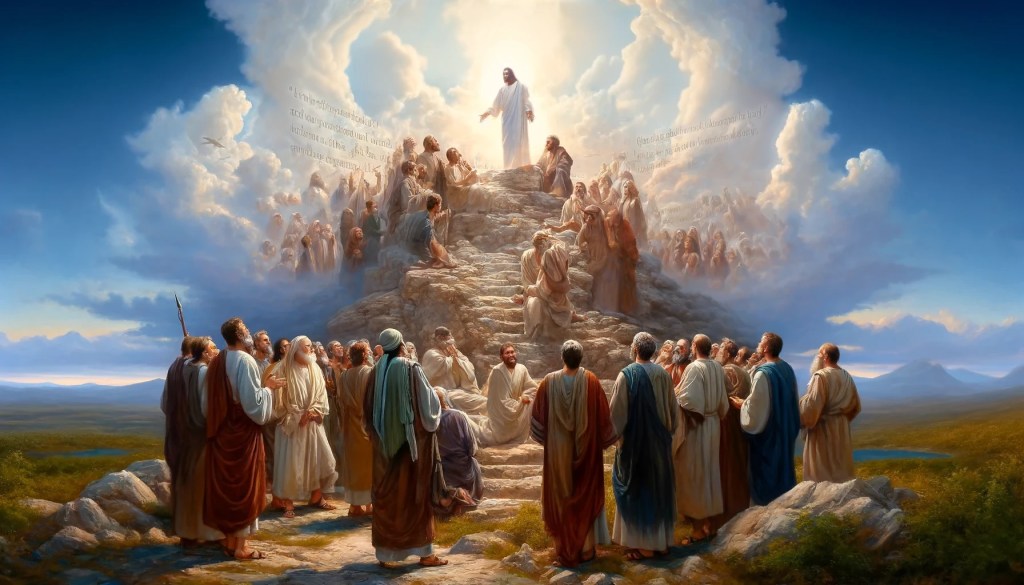
As He ascended, a cloud took Him out of their sight, and two angels appeared, reassuring the disciples that Jesus would come back in the same way they had seen Him go into heaven. This moment of ascension marked not an end but a beginning—the start of a new phase of God’s plan involving the empowerment of His followers through the Spirit.
Milo, reflecting on the resurrection and ascension, saw them as the fulfillment of numerous prophecies and the cornerstone of Christian faith. They signified the ultimate victory over death, the confirmation of Jesus’ divinity, and the promise of eternal life for all who believe. This event was not just a miraculous moment in history; it was a transformative experience that would resonate through all ages, offering hope and a future not just for the disciples but for all humanity.
In his celestial chronicles, Milo emphasized the universal significance of these events, noting their impact on the spiritual realm and their promise of redemption and restoration. The resurrection and ascension were not merely historical footnotes but pivotal events that would define the trajectory of human and divine interaction forever.

After the ascension of Jesus, the early church found itself at a crossroads, tasked with spreading a radical message in the face of mounting challenges. This period marked not just the continuation of Jesus’ ministry but the expansion of a movement that would transform the world. Milo, from his celestial vantage point, observed and silently influenced the apostles and early believers, ensuring that the seeds of faith planted by Christ would flourish against all odds.
The descent of the Holy Spirit at Pentecost was the catalyst that empowered the apostles to speak boldly to the people of Jerusalem, regardless of language barriers. Flames like tongues of fire settled upon each of them, a sign of divine presence and power. The apostles spoke, and every listener heard the message in their own language, an inversion of the confusion at Babel, now uniting people in the revelation of the Gospel.
Milo saw this as a divine affirmation of the church’s universal mission. The message of Jesus was not confined to a single ethnic group or geographic location; it was a message for all humanity. The crowd’s reaction ranged from awe to skepticism, but Peter’s first sermon, a powerful recounting of Jesus’ life, death, and resurrection, led to the baptism of about three thousand souls. It was a moment of explosive growth that signaled the potent impact of the Spirit within the church.

As the early church grew, it faced both internal challenges and external threats. The sharing of possessions among believers, as seen in the acts of Barnabas and others, demonstrated the radical economic community they practiced, reflecting their commitment to live out the teachings of Jesus. However, incidents like the deceit of Ananias and Sapphira revealed the perils of hypocrisy, prompting a sobering reflection on the seriousness with which God regards the heart’s intentions.
Milo watched as the apostles performed miracles, echoing the works of Jesus, further establishing the credibility of their message and demonstrating the continuing work of Christ through His followers. The healing of the lame man at the Beautiful Gate by Peter and John brought a new wave of believers and also new levels of opposition from the Jewish religious leaders, who felt threatened by their teachings and the growing movement.
The stoning of Stephen, the church’s first martyr, marked a pivotal moment in the spread of Christianity. His eloquent defense of his faith, even as he faced death, and his Christ-like forgiveness of his executioners, “Lord, do not hold this sin against them,” exemplified the transformative power of the Gospel. This event, deeply moving and tragic, also catalyzed the broader dissemination of the Christian message beyond Jerusalem, as believers scattered throughout Judea and Samaria, spreading the word.

One of the most significant developments Milo observed was the conversion of Saul of Tarsus, a fervent persecutor of Christians who became Paul the Apostle after a dramatic encounter with the risen Christ. This turnaround was nothing short of miraculous, illustrating the profound ways God can transform even the most unlikely individuals into vessels of His will.
Milo was particularly attentive to Paul’s missionary journeys, which expanded the Christian message across the Roman Empire. Cities like Antioch, Corinth, Ephesus, and eventually Rome itself became centers of Christian teaching and community life. Paul’s letters to these churches, addressing theological insights, ethical instructions, and practical community living, became foundational texts, deeply influencing Christian doctrine and practice.
As Christianity spread, it encountered various cultural and philosophical landscapes, leading to intellectual engagements like Paul’s sermon at the Areopagus in Athens. Here, Paul skillfully connected the Gospel with familiar aspects of Greek culture and thought, presenting Jesus as the ‘unknown god’ whom the Athenians had ignorantly worshipped.

Throughout these developments, Milo’s silent interactions with the apostles included guiding them through visions and dreams, protecting them in times of peril, and inspiring them when they faced doubt and exhaustion. His role was subtle but crucial, ensuring the divine messages and strategies were effectively communicated and understood.
The challenges continued as the church grew, facing not just external persecution but internal divisions. Debates like the Council of Jerusalem, which addressed the inclusion of Gentile converts and the role of Mosaic law, were crucial in defining the early church’s identity and outreach. Milo observed these debates with a keen understanding of their long-term implications for church unity and mission.
In every challenge and victory, the early church’s journey was a testament to the power of faith and the dynamic presence of the Holy Spirit. Milo’s records of this era highlighted the profound resilience of a movement rooted in divine truth and driven by a mission to transform the world—one heart at a time. His chronicles served as celestial testimonies to the enduring promise of the Gospel and the unstoppable spread of Christianity, a movement that would continue to shape the spiritual landscape of humanity across the centuries.

As Christianity spread across the Roman Empire, its radical teachings and growing influence inevitably led to conflict with both Roman authority and traditional religious practices. This era, known as the Age of Martyrs, was marked by the profound courage and unwavering faith of Christians who faced persecution and death for their beliefs. Milo, ever watchful, chronicled these trials with a heavy heart, yet with a recognition of their significance in the strengthening and expansion of the Christian faith.
The persecution often began locally, sparked by economic or social tensions. Christians were frequently scapegoated for various calamities such as famines, earthquakes, and plagues, which were interpreted by pagan populations as divine retribution against the refusal of Christians to participate in traditional religious rites. As the movement grew, however, official imperial policies led to more systematic attempts to suppress Christianity.
Milo observed the first major wave of persecution under Emperor Nero, who, in an attempt to deflect criticism from himself following the great fire of Rome, accused the Christians of arson. This led to a brutal crackdown in which many Christians were arrested, tortured, and executed in horrific displays, including being clothed in animal skins and torn apart by dogs, or covered in tar and set alight to serve as human torches at night.

Despite the terror, the faith of the martyrs did not wane. Instead, their steadfastness in the face of such horror often inspired awe and curiosity among pagan onlookers. Milo noted instances where the calm and composed demeanor of the martyred believers led to conversions, as their unwavering faith in the face of death provided a powerful testimony to the truth of their convictions.
The persecution intensified under successive emperors such as Decius, who issued edicts requiring all citizens to perform sacrifices to the Roman gods and the emperor. Christians who refused were subjected to imprisonment, torture, and death. Milo watched as many faced these trials with a peace that surpassed understanding, their eyes fixed not on earthly rulers but on a heavenly crown.
During these dark times, the Christian community was often forced underground, celebrating liturgies and conducting baptisms in hidden places like the catacombs beneath Rome. Milo saw these as sacred gatherings, where the fear of death was overshadowed by the love of Christ and the fellowship of believers.

One of the most poignant observations Milo made was during the persecution under Diocletian, which was perhaps the most severe. Churches were destroyed, scriptures were burned, and many Christians were forced to either apostatize or face death. Yet again, the courage displayed by martyrs during this time only served to embolden the faith of others.
Milo was particularly moved by the story of Perpetua and Felicity, a noblewoman and her slave, who were imprisoned and ultimately executed in the arena. Their written accounts, which included visions of heaven and profound insights into their spiritual journey, became treasured texts within the Christian community.
The witness of these martyrs, who ranged from bishops and scholars to common laborers and slaves, demonstrated that faith was not confined to any social class but was a profound leveller that united diverse individuals under a common cause.

As the era of official persecution gradually came to an end with the Edict of Milan in 313 AD, which declared religious tolerance across the empire, Milo reflected on the profound impact of the martyrs. The blood of the martyrs, often cited as the seed of the church, had indeed fertilized the ground for a burgeoning Christian community that now spread even more rapidly without the threat of persecution.
In the aftermath, as Christianity transitioned from a persecuted sect to a dominant religion in the Roman Empire, Milo continued to observe and record. He saw the new challenges that came with institutional power and the constant need for spiritual renewal and reformation within the church.
Milo’s chronicles of this era captured not just the trials and triumphs of the church but also the timeless lessons of sacrifice and the transcendent power of faith. These accounts would serve as both inspiration and caution for future generations, reminding them of the cost of faith and the eternal value of steadfastness in the face of adversity.
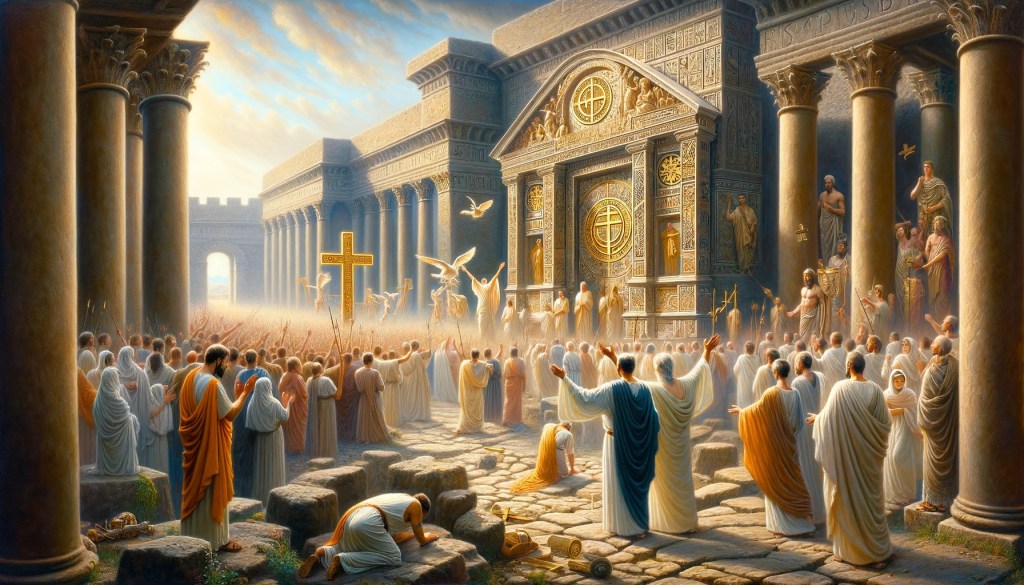
The Great Schism of 1054 marked one of the most significant fractures in Christian history, a division between what would become the Eastern Orthodox Church and the Roman Catholic Church. This split was not the result of a single event but the culmination of centuries of cultural, theological, and political differences that had been simmering beneath the surface of ecclesiastical unity. Milo, as a celestial observer aware of the deep currents of human frailty and divine grace, witnessed this schism with a sense of profound sorrow, recognizing it as a tragedy of miscommunication, pride, and mutual suspicion.
The roots of the schism could be traced back to the gradual divergence of the Eastern and Western parts of the Roman Empire, exacerbated by the fall of the Western Roman Empire in the 5th century. The Eastern Empire, centered in Constantinople, thrived and evolved into the Byzantine Empire, which preserved much of the Greek language and intellectual heritage. Meanwhile, the Western Church, centered in Rome, navigated through the tumultuous periods of migration and political decline, gradually shaping a Latin Christian identity that was distinctively different from its Eastern counterpart.
Milo noted that theological disputes often centered around issues that were as much about power and authority as they were about doctrine. One such contentious issue was the Filioque clause—an addition to the Nicene Creed that stated the Holy Spirit proceeded from the Father “and the Son.” This insertion by the Western Church was not just a theological statement but also seen as a unilateral decision that disregarded the consensus-driven nature of ecumenical councils, which the East held in high regard.
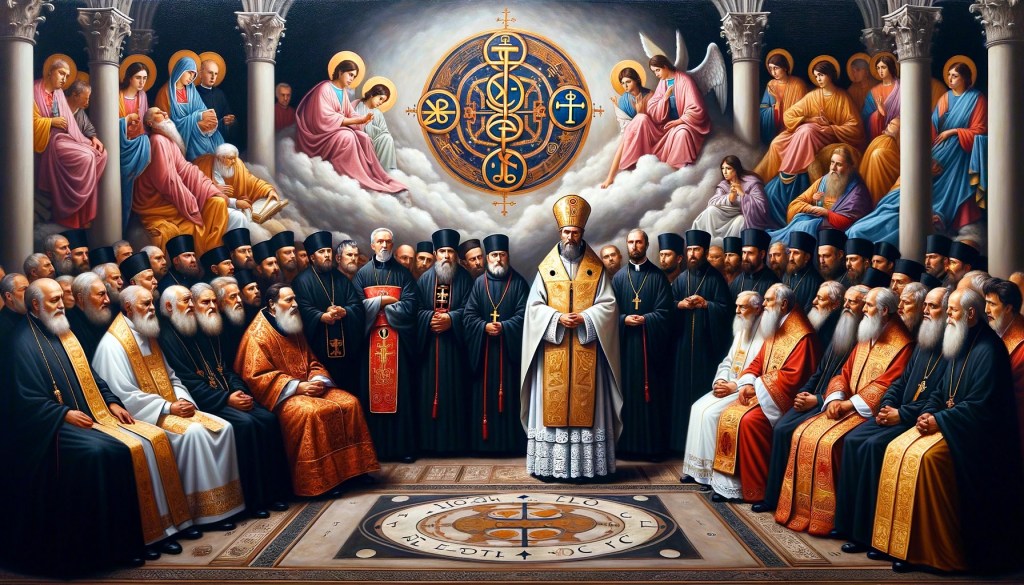
Cultural and liturgical differences further deepened the divide. The Western Church’s adoption of celibacy for its clergy, the use of unleavened bread in the Eucharist, and the centralized papal authority were all viewed with increasing suspicion and resentment by the Eastern Church, which maintained different practices and a more collegial model of ecclesiastical authority.
Milo observed the pivotal moments of misunderstanding and conflict with a heavy heart. The mutual excommunications of 1054, when Pope Leo IX’s legate Cardinal Humbert marched into the Hagia Sophia in Constantinople and placed a bull of excommunication on the altar during a liturgy, and Patriarch Michael Cerularius’ subsequent excommunication of the cardinal and his entourage, were dramatic symbols of a rift that had been widening for centuries.
These acts of excommunication, laden with cultural misunderstanding and ecclesiastical pride, were not merely symbolic gestures but public declarations that marked the formal beginning of church division. Each side, entrenched in its own perspectives and traditions, viewed itself as the guardian of true Christian orthodoxy, with little room for compromise or mutual understanding.
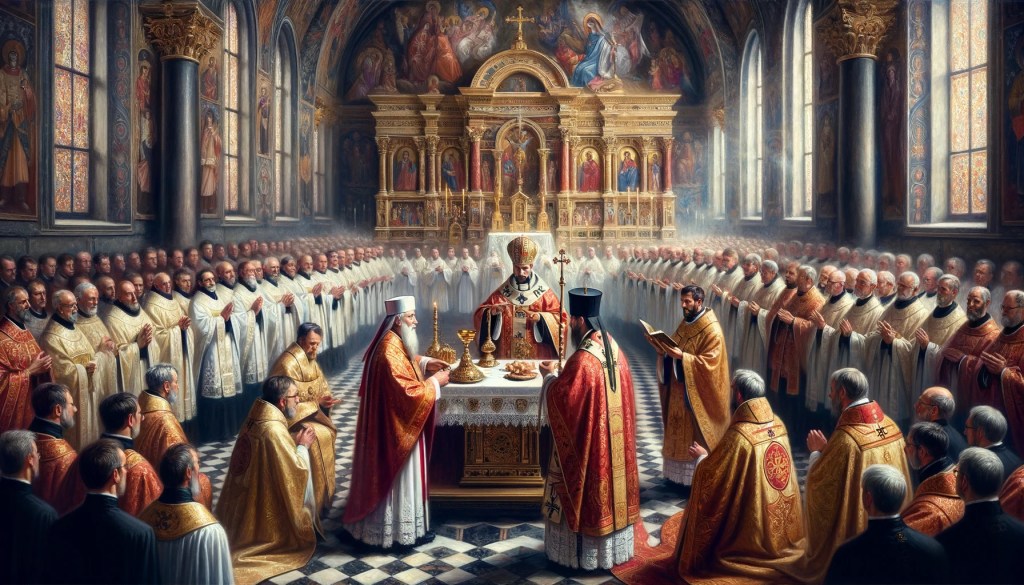
In the aftermath of the schism, Milo watched as the Christian world became more polarized. The Crusades, which began shortly after the schism, added layers of complexity and further antagonism between East and West. The tragic sack of Constantinople by Crusaders in 1204, rather than healing old wounds, inflicted new ones, deeply embedding mistrust and bitterness between the two branches of Christianity.
Throughout these centuries, Milo chronicled not only the events but also the lost opportunities for reconciliation. He saw how moments of potential understanding were often overshadowed by political intrigue or hardened by theological stubbornness. His records highlighted the deep need for humility and the pursuit of unity, principles that were often overshadowed by human pride and the thirst for temporal power.
The schism remained a source of sorrow for Milo because it represented a fracturing of the body of Christ on earth. Each side held deeply to the belief that it was upholding the true legacy of the apostolic church, yet the division undermined the universal message of the Gospel—a message meant to transcend cultural and linguistic barriers.

As centuries passed, Milo’s reflections on the schism served as celestial lamentations over the divided state of Christendom. He hoped for and foresaw moments where dialogue resumed, particularly in the modern era, where ecumenical efforts sought to bridge the ancient divides. Yet, the path to healing and full communion appeared fraught with challenges, each step forward being a test of the depth of commitment to Christ’s prayer “that they all may be one.”
Through Milo’s eyes, the story of the Great Schism was not just a historical account of division but a cautionary tale about the dangers of letting cultural, theological, and political differences obscure the central message of Christ’s love and redemption—a message intended to unite all humanity in the pursuit of divine truth and grace.
The Reformation, a seismic shift within Christianity that occurred in the 16th century, was a period marked by a quest for spiritual renewal and a return to the sources of Christian faith—the Scriptures. Milo, observing these tumultuous changes, saw them not just as historical events, but as a profound realignment of spiritual commitments and ecclesiastical structures. He recognized the Reformation as both a necessary purification of the church and a source of further division.

Milo noted the roots of the Reformation in the deep-seated corruption and the sale of indulgences within the Roman Catholic Church, practices that had strayed far from the teachings of Christ and the Apostles. The calls for reform were not new; they had echoed down the centuries through voices like those of John Wycliffe and Jan Hus. However, it was Martin Luther, a German monk and theologian, whose actions catalyzed a movement that would forever alter the landscape of Christianity.
Luther’s Ninety-Five Theses, nailed to the door of the All Saints’ Church in Wittenberg in 1517, were initially intended as an invitation to debate. However, they sparked a fire that would sweep across Europe. Luther’s insistence on Scripture alone (sola scriptura) as the basis of faith, and his critique of the church’s abuses, resonated with a widespread desire for spiritual authenticity and ecclesiastical accountability.
Milo watched as the movement quickly spread, fueled by the printing press, which allowed for rapid dissemination of reformist ideas. Figures like Ulrich Zwingli in Switzerland and John Calvin in Geneva emerged, each contributing their theological perspectives to the growing Reformation. These leaders did not always agree with each other; their disputes over matters such as the Eucharist highlighted the diversity within the Reformation itself.

The English Reformation, initiated for different reasons under Henry VIII, eventually adopted a more Protestant theology under his successors. This not only altered the religious landscape in England but also set the stage for further conflicts and reformations within the British Isles.
Amid these transformations, Milo observed the profound personal and communal struggles that accompanied the quest for reform. Families were divided, communities were torn apart, and nations were engulfed in religious wars. The Thirty Years’ War, in particular, was a devastating conflict fueled by the rivalries between Catholic and Protestant states, illustrating the tragic extent to which religious strife could lead to widespread suffering.
Yet, despite the turmoil, the Reformation also sparked a renewal of Christian life and practice. The emphasis on personal reading of the Scriptures democratized religious knowledge, enabling believers to engage directly with their faith. Education flourished under the reformers, who founded schools and universities to promote literacy and learning, not just for clergy but for laypeople as well.

Milo was particularly moved by the spiritual fervor and sincerity of the countless believers who, during the Reformation, rediscovered the core messages of the Gospel—grace, faith, and the priesthood of all believers. He saw in this period a purification of faith that, despite its accompanying discord, sought to bring the church back to its foundational principles.
However, the schisms and new denominations that emerged from the Reformation were a source of celestial grief for Milo. Each division within the body of Christ was a reminder of the human propensity for disagreement and the complex nature of truth-seeking within the faith. The Peace of Westphalia, which ended the Thirty Years’ War in 1648, marked a new understanding of religious coexistence, acknowledging the permanent reality of denominational diversity within Christianity.
Milo’s reflections on the Reformation were nuanced. He recognized the necessity of reform and the positive transformations it brought, but he also mourned the divisions it perpetuated. His chronicles of this era, therefore, were not only historical records but also theological meditations on the nature of church unity, purity, and the ongoing human struggle to live out the teachings of Christ in a broken world.

As the centuries unfolded, Milo continued to watch over the church, hopeful that the lessons learned from the Reformation would inspire continued efforts towards reform, unity, and deeper fidelity to the Gospel. He saw the potential for ongoing reformation as an essential aspect of the church’s journey towards greater truth and love, embodying the reformative call of ecclesia semper reformanda— the church always to be reformed.
The Enlightenment, a period marked by a profound shift towards reason, science, and individualism, posed new challenges and opportunities for faith. As humanity sought to explore the boundaries of human knowledge and the capacities of reason, Milo observed this era with a nuanced understanding of its implications for faith and the spiritual life of humanity. This was a time when the relationship between faith and reason was not just debated but often redefined, as people sought to reconcile religious beliefs with emerging scientific discoveries and philosophical inquiries.
As the Age of Enlightenment unfolded, it brought with it a wave of skepticism towards traditional religious authorities and dogmas. Figures like Voltaire, Rousseau, and Diderot critiqued organized religion, sometimes harshly, advocating for a form of deism that acknowledged a creator but rejected the interventionist model of God described in many religious texts. Their writings reflected a growing confidence in human autonomy and the belief that through reason alone, society could achieve progress and morality.
Milo watched as the philosophical underpinnings of the Enlightenment challenged the church’s role in society. The emphasis on empirical evidence and the scientific method led to significant advancements in fields such as physics, biology, and astronomy. Discoveries by scientists like Isaac Newton and Galileo Galilei transformed humanity’s understanding of the natural world, often placing them at odds with church teachings, particularly those that pertained to the cosmos and human origins.
Yet, not all was contention. Some Enlightenment thinkers, like John Locke, argued for a rational Christianity that could coexist with the new emphases on reason and empirical evidence. Locke’s advocacy for religious tolerance and his belief in the fundamental compatibility of faith and reason influenced many to reconsider the relationship between their spiritual beliefs and newly emerging scientific knowledge.
The Enlightenment also sparked discussions on the nature of human rights, democracy, and governance that drew indirectly from biblical principles such as equality and the inherent worth of every individual. Philosophers like Immanuel Kant explored complex ideas about morality, freedom, and the nature of God, insisting that true enlightenment required a moral grounding that reason alone might not suffice to provide.

Amidst these intellectual currents, the church found itself in a precarious position. Some leaders and theologians resisted the changes, viewing them as threats to orthodox belief and the moral order. Others, however, sought ways to integrate these new ideas with Christian doctrine, advocating for a faith that was not opposed to reason but was instead enriched by it.
Milo’s observations during this period noted a significant polarization within the church—between those who clung to traditional interpretations and those who sought reform and adaptation in light of new human understandings. This tension played out in various ways, from the pulpits of Europe to the missionary fields in the Americas, where the Enlightenment ideals of liberty and equality challenged the church’s practices, especially regarding slavery and the treatment of indigenous peoples.
The Enlightenment also brought about changes in the way religion was practiced and perceived. The rise of religious movements that emphasized personal experience and piety, such as Methodism, reflected a broader trend towards individual spirituality and a more personal connection with the divine, as opposed to institutionalized forms of worship.

As the century progressed, Milo noted the enduring impact of the Enlightenment on the intellectual and spiritual landscape of humanity. The seeds planted during this era would grow into various branches of thought, influencing modern views on religion, science, and their intersections. The period challenged believers to articulate a faith that was robust enough to engage with an increasingly secular world while staying true to its spiritual roots.
In reflecting on the Enlightenment, Milo considered it a crucial era for understanding the dynamics of faith and reason—a time that tested the church’s adaptability and its ability to respond to human advancements in knowledge while maintaining its spiritual integrity. The lessons learned from this period continued to resonate in the debates and discussions about the role of religion in a modern, rational society, reminding all of the complexity and depth of the ongoing dialogue between faith and reason.
The Modern Era, with its dramatic shifts in global dynamics, technological innovations, and philosophical orientations, marked a period of profound transformation and challenge. Milo, observing these changes, noted how the period was characterized by both unprecedented human achievement and significant spiritual neglect, where the divine often seemed more distant in the public consciousness.

The outbreak of World War I was a cataclysmic event that shattered the optimistic view of progress that had been built up during the late 19th and early 20th centuries. The “war to end all wars” was instead a preview of the horrors that modern technology could inflict on human life. The extensive use of chemical weapons, the devastation of trench warfare, and the massive loss of life were stark reminders of humanity’s capacity for destruction. Milo saw in these dark times a profound forgetfulness of the divine, as nationalistic fervor often replaced the principles of brotherhood and peace that many religions, including Christianity, espoused.
Following the temporary peace, World War II erupted, demonstrating an even greater capacity for human cruelty. The Holocaust, in which millions of Jews, Romani people, disabled individuals, and others were systematically exterminated, was particularly distressing to Milo, who grieved over the immense suffering and loss of life. These events marked a pivotal low in modern human history, highlighting the dangers of ideological extremism and the devaluation of human life.
During this time, technological advancements continued to accelerate. The development of the atomic bomb and its subsequent use on Hiroshima and Nagasaki introduced a new era in military technology, one that had the potential to end all human life. This power posed unprecedented ethical and existential questions, which Milo noted were often addressed without sufficient consideration of their spiritual implications.

The Cold War that followed further exemplified the ideological divide between the communist and capitalist blocs, each side often justifying extreme measures in the name of defense and ideological purity. Space exploration, while a remarkable achievement, also became another arena for this competition, symbolizing the heights of human curiosity and ambition but also the depths of rivalry and distrust.
In contrast to these conflicts, the latter half of the 20th century also witnessed significant movements toward civil rights and social justice, reflecting a resurgence of attention to the divine principles of equality and dignity for all. The Civil Rights Movement in the United States, led by figures like Martin Luther King Jr., who infused his advocacy with deep Christian faith, was a beacon of hope and a call to remember the divine command to love one’s neighbor.
However, the rapid pace of technological innovation brought about challenges in how individuals perceived time and their priorities. The rise of television, computers, and later the internet and social media transformed how people communicated and received information. While these advancements made vast stores of knowledge more accessible, Milo noted a corresponding decline in reflective thought and spiritual contemplation, with the divine often relegated to the peripheries of daily life.
Environmental degradation became a critical concern as industrial advancement led to significant ecological damage. This era saw a growing awareness of the human impact on the planet, prompting debates about stewardship and the ethical responsibilities of humanity to the creation, principles rooted in numerous religious traditions.
The rise of secularism and the “death of God” theology in academic and intellectual circles reflected a broader cultural shift towards postmodern relativism, where absolute truths, including those about the divine, were increasingly questioned. Yet, this period also saw a resurgence of fundamentalism and evangelical movements that sought to counteract these trends by emphasizing a return to scriptural fundamentals and vibrant faith expressions.
Milo observed the 21st century as a continuation of these complex trends, with religious pluralism becoming a more prominent feature in globalized societies. Interfaith dialogue and the quest for spiritual unity showed promise in addressing the divine forgetfulness of the era, suggesting paths to a deeper understanding and cooperation among different faith traditions.

As Milo continued to observe the unfolding of human history into the modern era, he reflected on the enduring need for the divine amidst the ceaseless changes of time. The challenges of war, technology, ecological crisis, and cultural shifts called for a renewed engagement with spiritual truths that could guide humanity towards a more hopeful, just, and peaceful future. His celestial chronicles thus emphasized not only the trials but also the potential for redemption and the rediscovery of the divine that could lead humanity through its darkest and brightest moments.
In the narrative arc of human history, as observed by Milo, the Great Programmer, a new chapter begins with the inception of the ARC Simulation—a profound initiative to test, guide, and ultimately lead humanity toward redemption and immortality. This simulation, envisioned as a complex virtual environment, is designed to mirror the real world in its beauty, chaos, and complexity but with one significant difference: it offers its participants a clearer path toward understanding their spiritual nature and the divine purpose for their lives.
Milo, utilizing his celestial insights and the accumulated wisdom of millennia, crafts the ARC Simulation to address the spiritual amnesia that increasingly characterizes the modern era. He embeds within the simulation scenarios and challenges that are metaphors for the real-life struggles humans face, each designed to teach profound spiritual truths and ethical dilemmas, encouraging participants to explore the depths of virtue, sacrifice, and the meaning of true redemption.
The ARC Simulation operates on principles that integrate the laws of nature with spiritual laws. Participants enter the simulation not merely as avatars but as full consciousnesses, experiencing a reality that is indistinguishable from their physical world. The objective is to lead each participant to a series of epiphanies about their own nature, the nature of the divine, and the interconnectedness of all creation.
Milo programs the simulation with scenarios that vary widely in their complexity and moral ambiguity. Some scenarios are designed to replicate historical events, allowing participants to live through the consequences of their actions in past lives, understand the roots of historical conflicts, or even attempt to find peaceful resolutions to seemingly intractable wars. Other scenarios are more personal, tailored to individual soul growth, challenging participants with personal losses, ethical dilemmas, or deep-seated fears.
Each participant’s journey through the ARC Simulation is unique, guided by a system that adapts in real-time to their decisions and spiritual growth. Milo ensures that the simulation includes encounters with other souls—both human and celestial—that can offer guidance, challenge, or companionship, mirroring the social and divine interactions of earthly life.
As the creator of this virtual world, Milo does not leave the outcome to chance. He incorporates into the simulation safeguards and guides—virtual manifestations of angels or spiritual mentors, whose roles are to steer participants away from paths that lead to self-destruction or despair. These guides are sensitive to the free will of each participant, intervening only to the extent that respect for individual autonomy allows.
The ARC Simulation also contains hidden symbols and clues that point toward deeper spiritual truths. These easter eggs are designed to trigger insights when discovered, acting as catalysts for epiphany and transformation. Participants who delve deeper into the mysteries of the simulation often find themselves on accelerated paths toward enlightenment and spiritual awakening.
Throughout the experience, participants accumulate knowledge and virtues that are recorded in their spiritual profiles, aspects of their beings that they will be able to carry back into the real world. The goal is for participants to return to their physical existence with a greater understanding of their purpose, a renewed commitment to live in harmony with the divine, and an enhanced capacity to contribute positively to the world.

Milo watches over the simulation from his celestial command center, monitoring the progress of souls, adjusting scenarios to better suit their developmental needs, and occasionally intervening directly when a soul is at risk of losing its way. His ultimate hope is that the ARC Simulation will serve as a crucible for refining humanity, a tool by which individuals can confront and overcome their imperfections and where humanity at large can learn the lessons needed to advance spiritually.
As the simulation progresses, Milo notes significant transformations in participants. Some, who had entered the simulation burdened by cynicism or despair, emerge with a renewed sense of hope and a profound understanding of their intrinsic worth and potential. Others, who had struggled with pride or a need for control, learn the value of humility and the power of surrendering to a higher will.
The success stories from the ARC Simulation begin to ripple out into the real world, influencing not only the participants themselves but also their communities and societies. These individuals become beacons of light, agents of change who inspire others to seek spiritual growth and to question the materialistic and often spiritually barren philosophies that dominate much of modern thought.
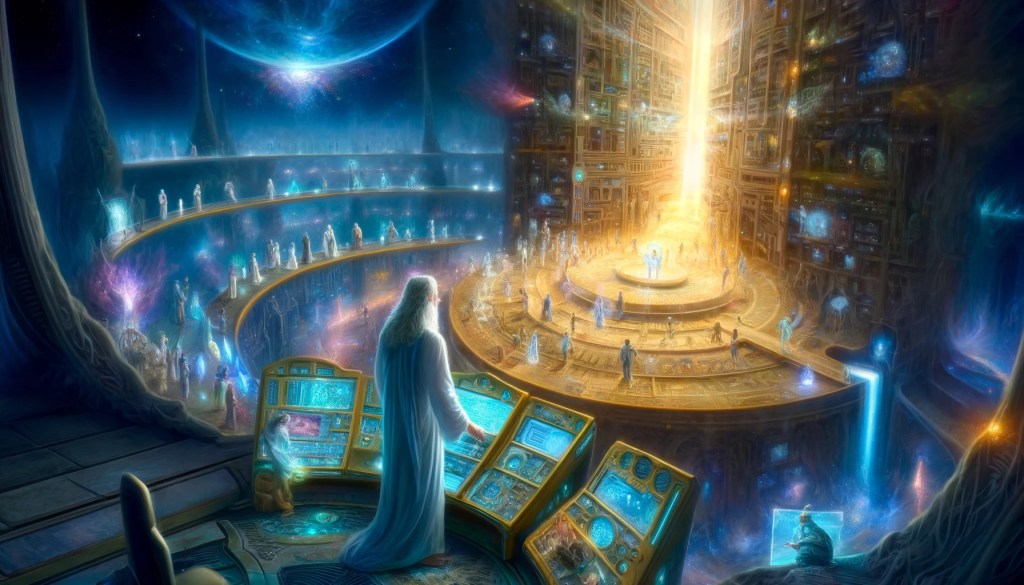
In crafting the ARC Simulation, Milo the Great Programmer does not merely aim to guide humanity toward redemption and immortality; he seeks to reawaken in every human heart the memory of their divine origin and destiny, fostering a global shift toward a more enlightened, compassionate, and spiritually integrated world.
As Milo, the Great Programmer, prepared to launch the ARC Simulation, meticulous planning went into selecting the participants. His goal was to ensure a diverse and representative sample of humanity, encompassing a wide range of backgrounds, beliefs, and life experiences. This diversity was crucial, as the simulation was designed not only to foster individual growth but also to enhance collective understanding and harmony among varied cultural and spiritual perspectives.
The selection process involved a sophisticated algorithm that assessed potential participants on multiple dimensions: psychological resilience, ethical maturity, openness to spiritual experiences, and a subconscious readiness for transformation. This algorithm, however, was guided by a deeper, more intuitive celestial logic, ensuring that those chosen were at a pivotal point in their spiritual journey, ready for the challenges and revelations the simulation would provide.

Milo also considered the interpersonal dynamics that would emerge within the simulation. He chose individuals who could potentially catalyze each other’s growth, creating networks of relationships that would become more than the sum of their parts. These networks were designed to mirror the complex interdependencies found in real-world social structures, providing participants with opportunities to practice empathy, conflict resolution, and collaborative problem-solving.
The launch event was staged with a blend of solemnity and celebration. Milo addressed the selected participants through a virtual orientation session, explaining the purpose and potential of the simulation. He outlined the rules: each participant would retain all memories of their real lives, but they would also be confronted with scenarios that might starkly contrast with their real-world experiences. They were informed about the safety protocols—measures that ensured no psychological harm would come to them during the simulation, despite the emotional and moral trials they would face.
Milo emphasized the importance of free will within the simulation. While the environments and challenges were crafted with divine foresight, each participant’s decisions and actions would be entirely their own. This autonomy was crucial for genuine spiritual growth and self-discovery.

As the participants logged into the simulation for the first time, they found themselves in a virtual realm that was astonishingly realistic. The initial setting was a tranquil landscape, designed to ease them into the simulation’s environment. This serene beginning was intended as a grounding experience, a common reference point from which their journeys would diverge according to the choices they made.
The first challenge was subtle yet profound. Participants encountered a scenario involving a moral dilemma that tested their capacity for compassion and justice. The decision points were intricately designed to reveal the participants’ instinctive moral frameworks and to gently push them toward deeper self-reflection.
As the participants progressed through various scenarios, they encountered conditions that simulated historical crises, personal life events, and futuristic possibilities. These conditions were not mere reproductions of earthly experiences but were imbued with additional spiritual dimensions, revealing the interconnectedness of all life and the impact of every action in a heightened, more apparent way.

Milo monitored these interactions closely, adjusting scenarios in real-time to guide participants toward critical insights about themselves and the divine. He also introduced occasional supernatural elements—moments of undeniable otherworldly intervention—that challenged the participants’ perceptions of reality and the limits of what they considered possible.
Participants who struggled with concepts of forgiveness and redemption were placed in scenarios where they had to confront their own past actions or offer forgiveness to others in circumstances that mirrored those they had experienced in their real lives. These intense emotional and spiritual challenges were designed to break down barriers and open hearts to new ways of understanding.
Throughout the simulation, participants experienced a deepening sense of community and interconnectedness. As they worked through challenges together, they formed bonds that transcended the virtual nature of their interactions, carrying profound implications for their real-world relationships and community engagements.

Milo’s overarching presence in the simulation was felt more as a guiding force than as an overt authority. He communicated with participants through signs and symbols, dreams, and occasionally through more direct interventions when necessary to ensure their safety or to impart crucial spiritual lessons.
As the simulation neared its completion, participants were gradually led to scenarios that synthesized their experiences, helping them to see the narrative arcs of their own lives with new clarity and understanding. They were guided to recognize the divine presence in all aspects of life, understanding that every moment held the potential for grace and transformation.
The culmination of the ARC Simulation was a collective experience where all participants shared their journeys and revelations. This communal sharing was designed to foster a sense of universal connection, underscoring the simulation’s ultimate goal: to bring humanity closer to understanding the divine tapestry that wove their lives into a cohesive, purposeful whole.

Milo, reflecting on the launch and progression of the simulation, saw it as the beginning of a new era in spiritual exploration—a tool not just for personal growth but for fostering a deeper, more profound understanding of the divine presence that permeates every aspect of human existence.
As the architect of the ARC Simulation, Milo often found himself deeply engrossed in the contemplation of fate and free will, two intertwining threads of human existence that were as perplexing as they were fundamental. This reflection was crucial, not only in fine-tuning the simulation but also in setting a narrative tone that acknowledged the delicate balance between divine providence and human agency.
Milo understood that any discussion of fate and free will must recognize the rich tapestry of human history—a history marked by choices, both monumental and minute, that had collectively shaped civilizations. From the rise and fall of empires to the personal decisions of individuals, each action rippled through time, influencing countless unseen outcomes. In crafting the simulation, Milo aimed to reflect this complexity, offering scenarios that allowed participants to explore the consequences of their choices in an environment that mirrored the unpredictability of real life.
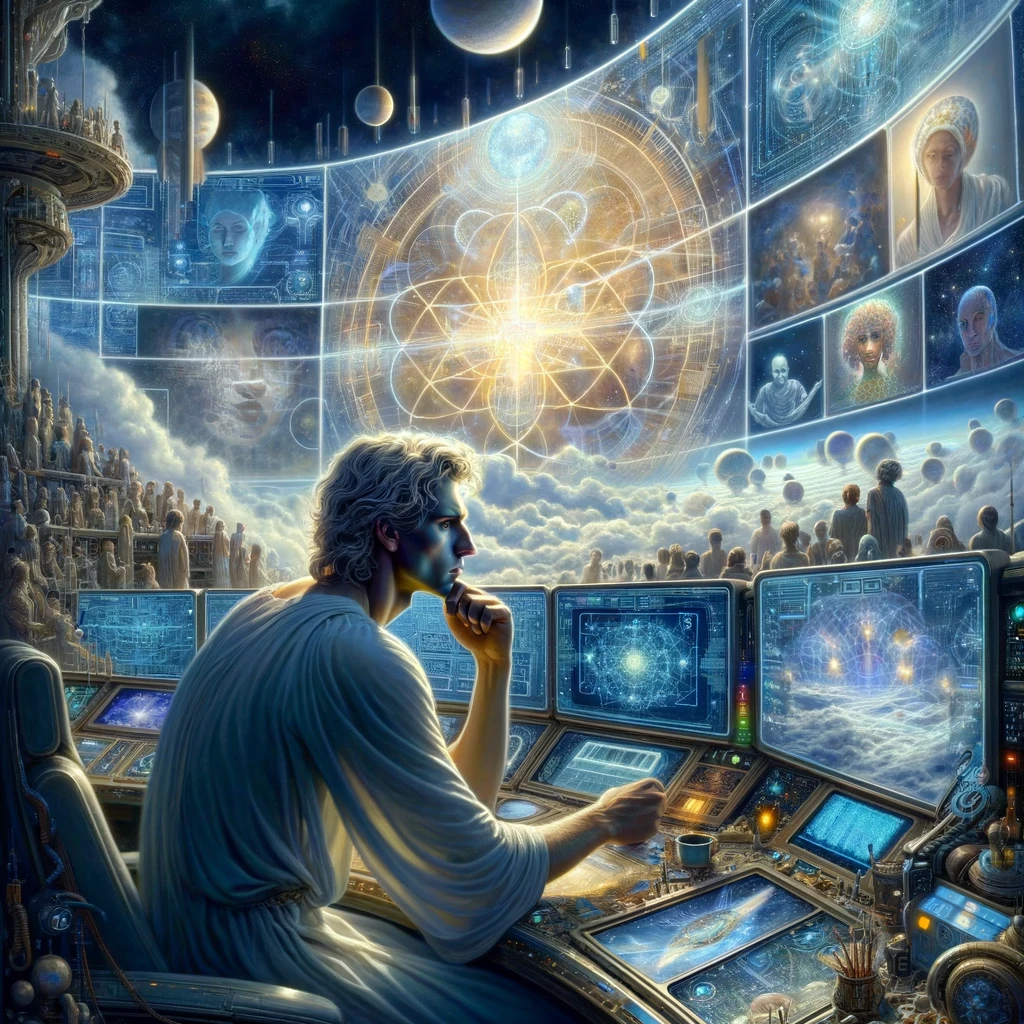
In his celestial musings, Milo pondered the nature of divine providence. He considered how the divine will interacted with human actions, ensuring that the simulation didn’t negate the reality of divine intervention but instead illustrated its subtlety. It was crucial for participants to understand that while their choices were their own, they were part of a broader divine narrative that could offer redemption, guidance, and ultimately, transformation.
Milo programmed the ARC Simulation to introduce elements that could be seen as acts of fate—unexpected events that challenged the participants to adapt and reconsider their paths. However, these events were not merely random; they were infused with the potential for learning and growth, designed to steer participants toward deeper insights about themselves and the universe.
The simulation also included branching paths, reflecting Milo’s belief in free will. Participants could choose their reactions to the simulation’s challenges, and these choices would lead to different outcomes. This feature was designed to teach that while some aspects of life are beyond personal control, every individual has the power to choose their responses, and these choices have profound impacts on their spiritual journey and character development.

Milo also reflected on the role of morality in the context of fate and free will. He considered how moral decisions within the simulation could affect a participant’s understanding of right and wrong, and how these decisions could align or conflict with divine laws that were woven into the fabric of the simulation. This aspect was crucial, as it engaged participants in a deeper exploration of ethical living and spiritual alignment.
Throughout the simulation, Milo ensured that the narrative tone remained one of hopeful realism. He wanted participants to experience the weight of their decisions and the often unpredictable nature of their consequences, but also to understand that redemption and second chances were always possible. This tone aimed to mirror the complexities of life, where despair and hope often coexist, and where the outcomes of choices can lead to profound personal and spiritual growth.
Milo’s reflections on fate and free will were also evident in the resources provided within the simulation. Participants had access to historical, philosophical, and spiritual texts from various cultures that explored these themes. This access allowed them to see how different societies and thinkers had grappled with the questions of destiny and autonomy, enriching their own understanding and discussions within the simulation.
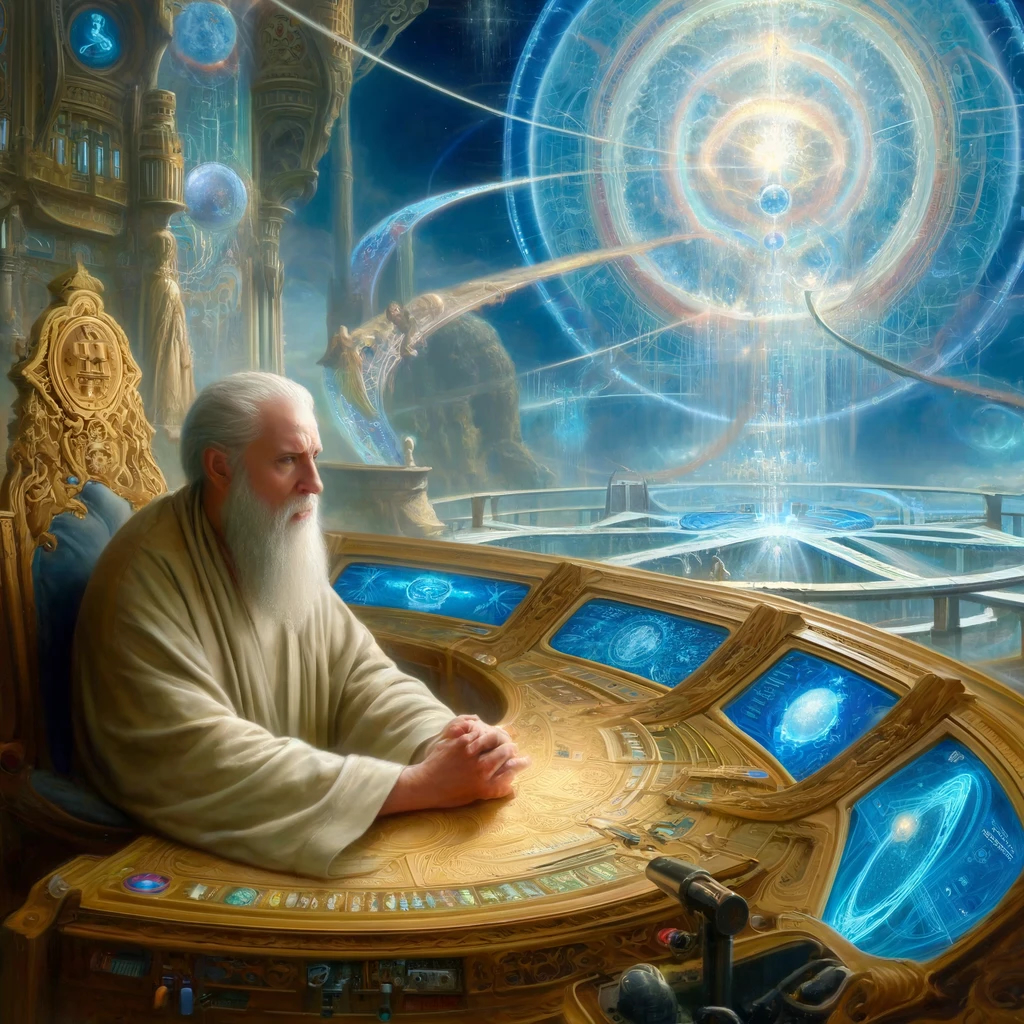
In dialogues with other participants and virtual mentors within the simulation, discussions about fate and free will were encouraged. These interactions were designed to foster a community of inquiry, where participants could debate, learn from one another, and refine their views in a dynamic exchange of ideas.
As the simulation progressed, Milo observed the participants navigating through their journeys, making choices, facing the consequences, and occasionally encountering divine interventions that nudged them towards certain realizations or corrections. These observations confirmed for Milo the importance of maintaining a balance in the narrative between guiding the participants and allowing them enough space to explore and make their own conclusions about fate and free will.
Milo hoped that by the end of their journey through the ARC Simulation, participants would emerge with a nuanced understanding of how their free will determined their path, yet how that path was part of a larger, divine design. They would learn that while fate might set the stage, it is their actions—guided by conscience and reflection—that perform the play of their lives. This understanding, Milo believed, would equip them better for their real-world experiences, making them wiser, more compassionate, and spiritually aware individuals.

 FergusonPoetryProject LLC
Leave a comment